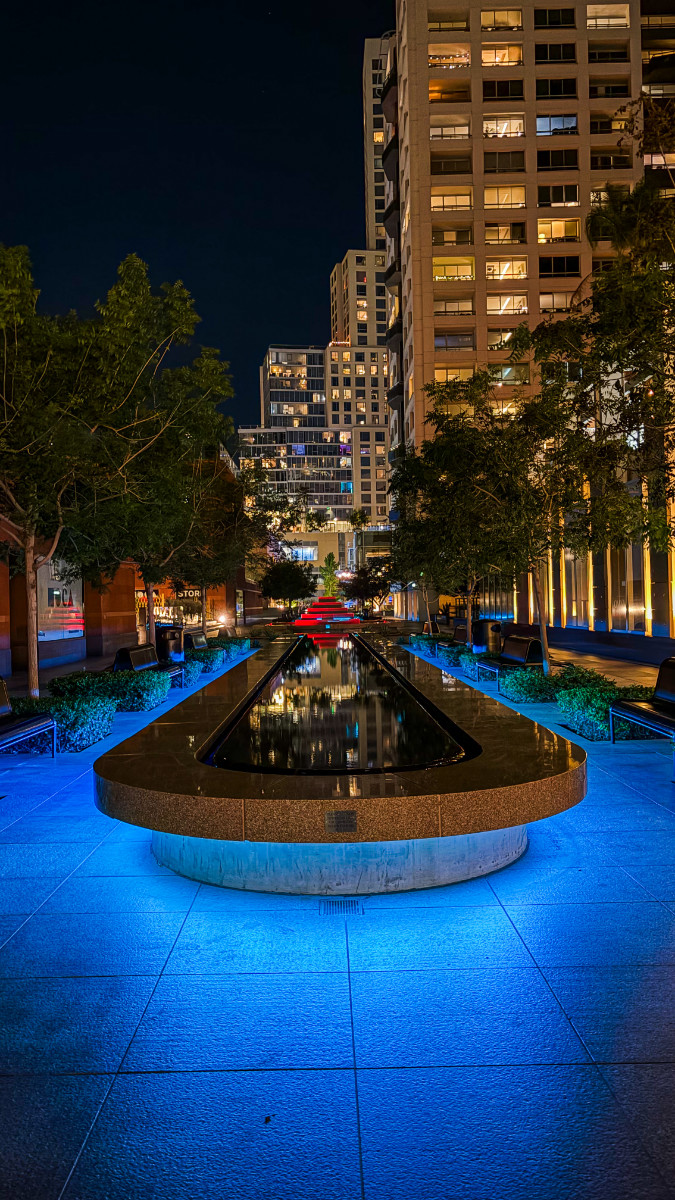
Behind MOCA
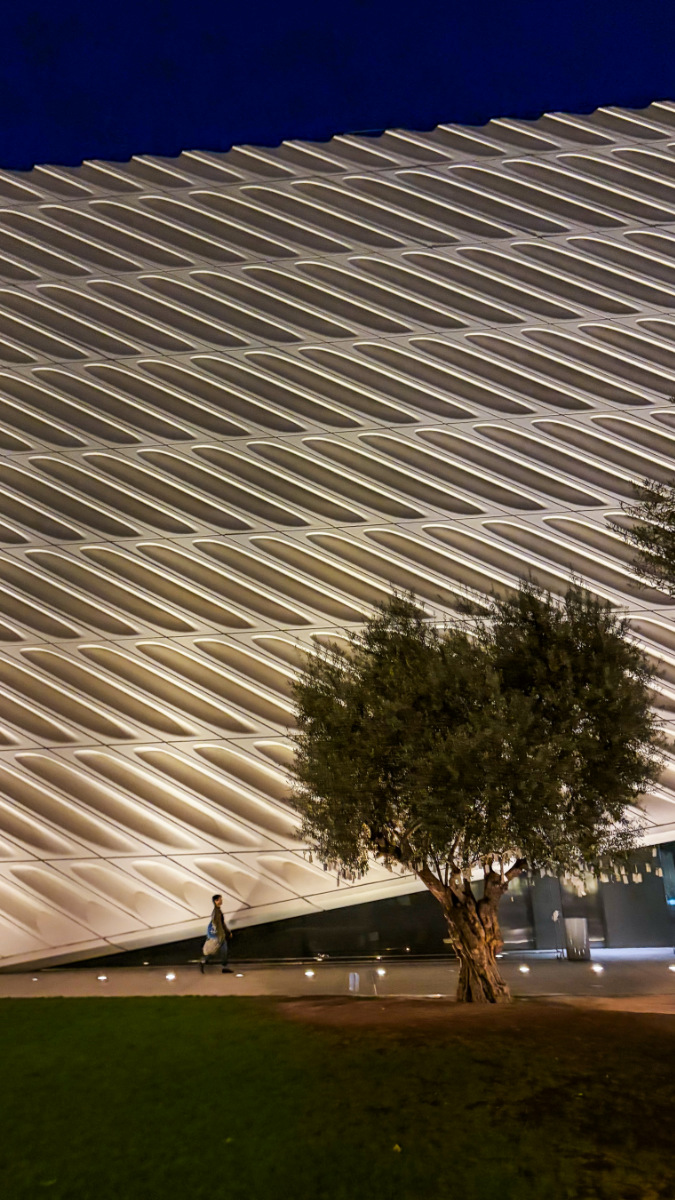
The Broad
Behind MOCA
The Broad
Downtown LA is the strangest metropolitan center I’ve ever seen. During the day there are cars everywhere. The freeways surrounding the area are packed, someone is always honking at a stoplight, the busses maneuver around cyclists. But the people? Almost the opposite. A few areas, like the 7th street Metro station or Little Tokyo, have a fair amount of foot traffic but a substantial amount of the city is proportionally sparse compared to New York (or even a smaller city like Boston or San Francisco).
At night, it’s even emptier. I was early for a concert Monday night so I walked around for half an hour or so and saw maybe a total of ten people, most of whom were walking their dog. Granted, I was up by the museums where there aren’t really any restaurants open but it’s a pretty common sight all over—unless you’re on a block where there’s a venue with a performance scheduled, you’d probably be able to count the amount of people you see on one hand.
I’ve heard downtown wasn’t like this before the pandemic but I don’t have a reference for that. Maybe it’s because this is such a car-centric city, you don’t have people generally walking from subway stations to a destination in any given neighborhood, and the closest most people come to public interaction is seeing someone through the window of a car. But it’s still very strange and emphasizes a certain loneliness one can feel in LA. You understand there are four million people in within a 15-mile radius, but you wouldn’t know it to look around.
I hate The Grove. It’s one of two gaudy, outdoor malls in Los Angeles by a billionaire who lost the race for mayor four years ago (the other being The Americana). In the past, I’ve found myself at the latter to catch a movie in the middle of the day because it’s down the street from my mechanic and I’d need to kill a couple hours while my car was in the shop. The Grove, though, I avoided at all costs.
Now, I can’t. At least not if I want to see a new movie.
Since theaters re-opened in 2021 or 2022, I’ve been using AMC’s A-List membership. I see a shit-ton of movies and the cost pays for itself if I go just twice a month. However, I’ve also lived in East Hollywood that whole time—just a 12-minute drive from the Burbank multiplex with its 30 screens and free parking.
A couple months ago, I moved into what is basically my dream place. There’s really nothing to complain about—except now that I’m in Westlake, Burbank is a much further drive and now the closest AMC theater is at The Grove, with its 14 screens and $6 parking.
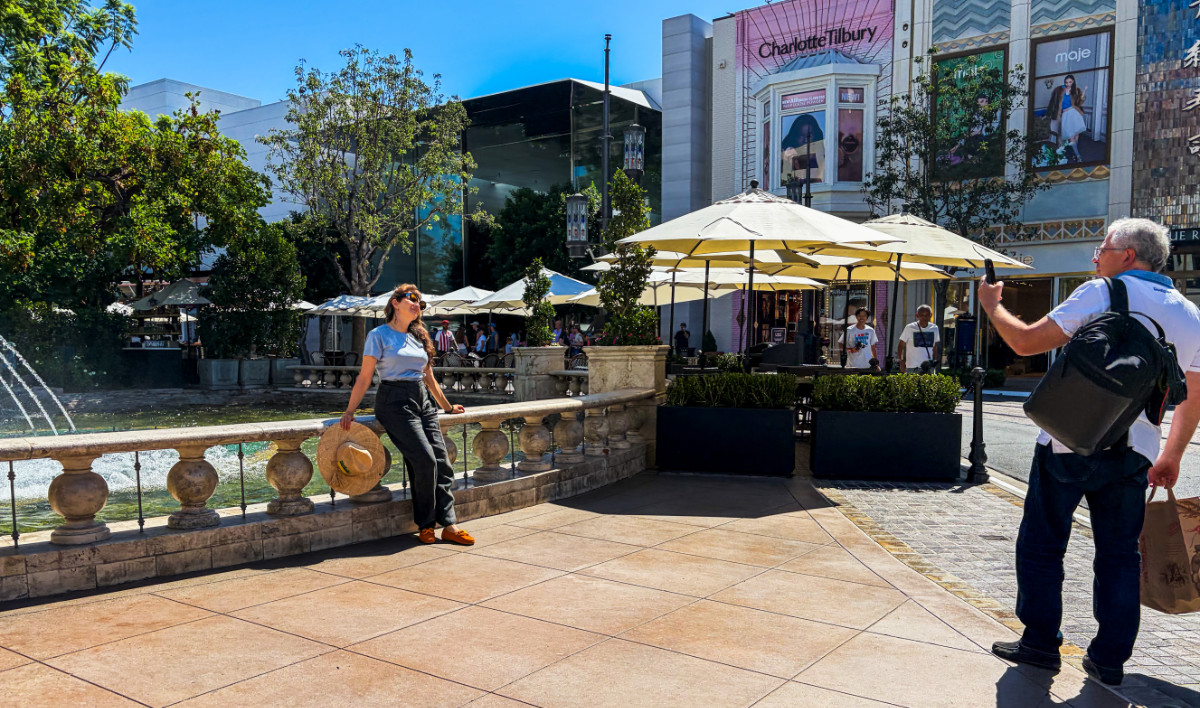
An afternoon at The Grove
There are any number of reasons I hate this place. An outpost of capitalism, there’s a kind of faux classiness to it all. There are ‘luxury’ stores but the experience of being at one of these malls is anything but. It’s the shopping center version of pleather. (Kind of ironic given Rodeo Drive is just three miles west, down Third to Beverly Hills.)
One thing going to The Grove does for me though, is that it reminds me how different people can be. It’s a real removal from my comfort zone. I walk around completely confused as to how people of all ages go to this place willingly and un-ironically, just to like, hang out. It is mystifying.
Consumerism in America is so central to national identity that places like The Grove really make me think about how the notion of what you want at a material level seeps in to every aspect of life—how being presented with certain options is disguised as being catered to, and what that means for how we view our politics. These sorts of places use the model of collective gathering to spur on the notion of individualism, and I think that’s far more destructive to the human condition of living in the United States than the specific economic model of capitalism (though the two are inextricably linked).
I haven’t really been writing much about politics these days. When I do, it tends to be pretty local or small-scale. Though I haven’t been making a ton of art, any political ideas never get too far.
Earlier this year, Conor Oberst talked about the difficulty of making protest-oriented art in the time of Trump. It’s the great paradox of Trump that is perhaps the most interesting thing about him: For a man with so many obvious character flaws, with only self-interest in his heart, he is remarkably difficult to actually insult. He is incredibly vain and therefore does care about image, but only in a specific capacity that art, or perhaps even language, doesn’t have a known capacity for.
Like I said, it’s a challenge, but one that I would think and hope any artist would be up for at least trying to overcome. That hasn’t really been my problem. Trump is just a guy, and in the end he’s a symptom of the disease, not the disease itself.
What has become impossible, though, is reconciling the parallel horrors that have become the background noise of everyday life. The ongoing genocide in Gaza being one line; the Epstein Files being another. Blatant evidence of human life being ruined or ended at a massive scale to no consequence at all.
I have to imagine the only parallel in the United States would be living during the time of the slave trade. Slavery allowed for the evil to be on display the way it is now being broadcast over social media—after slavery but before the internet, the forces of white supremacy could use the media to generally control the discourse around atrocities. They could two-sides any scandal.
But there’s no way out of this one. These events are a mirror. From Palestine to Little St. James, there is no excuse for the systems that are operating via child trafficking, murder, mass rape, or ethnic cleansing to continue—much less for those who participate in any of it to get away unscathed. There is no room for debate. At some point, a line must be drawn, and to my mind, we crossed it years ago.
I’ve always felt that art is the closest thing we have to being able to get a better understanding of the soul. But these past few years have been killing off whatever was left of that human spirit, to the point where I ask myself, What am I even trying to relate to anymore?
Making art right now feels like hosting a party inside of a burning house. Anyone who wants to be entertained in this moment isn’t someone I’d want to entertain. But the lack of consequences for these monumental horrors are now embedded in our culture. And that makes me feel I just don’t want to participate in that culture any longer.
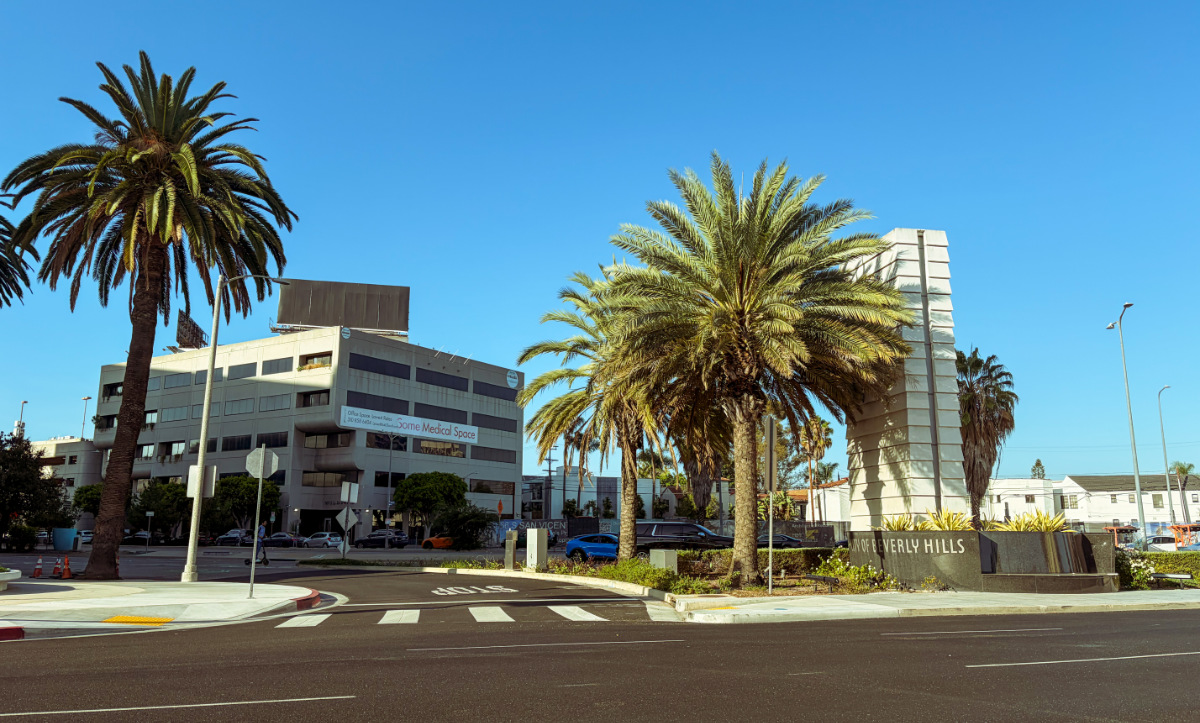
Wilshire and San Vicente
I had to get a new phone today. After years and years with my old iPhone SE, the screen cracked for the first time after I dropped it on Tuesday. The phone is so old that the repair shop didn’t have any screens in stock that would fit it. For some time now, it’s been slowly dying due to the increasing size of iOS and mobile apps, and so I took this as the final sign it was time to finally upgrade.
So I bought a new phone this afternoon. Afterward I had to go to Beverly Hills for a medical appointment, and I found myself sitting in the waiting room with some time to kill. Fiddling with this new iPhone, trying to figure out why Apple has made iOS so ugly over the past few years, I was struggling. Holding the phone along the base as I am used to, my thumb couldn’t reach the navigation buttons at the top of the screen—an action that was pretty simple on the SE. This seems like a flaw in basic functionality from a product design point of view, as my hands are a pretty decent size and should have no trouble reaching across a screen.
It felt really appropriate I was discovering this new inconvenience in Beverly Hills.
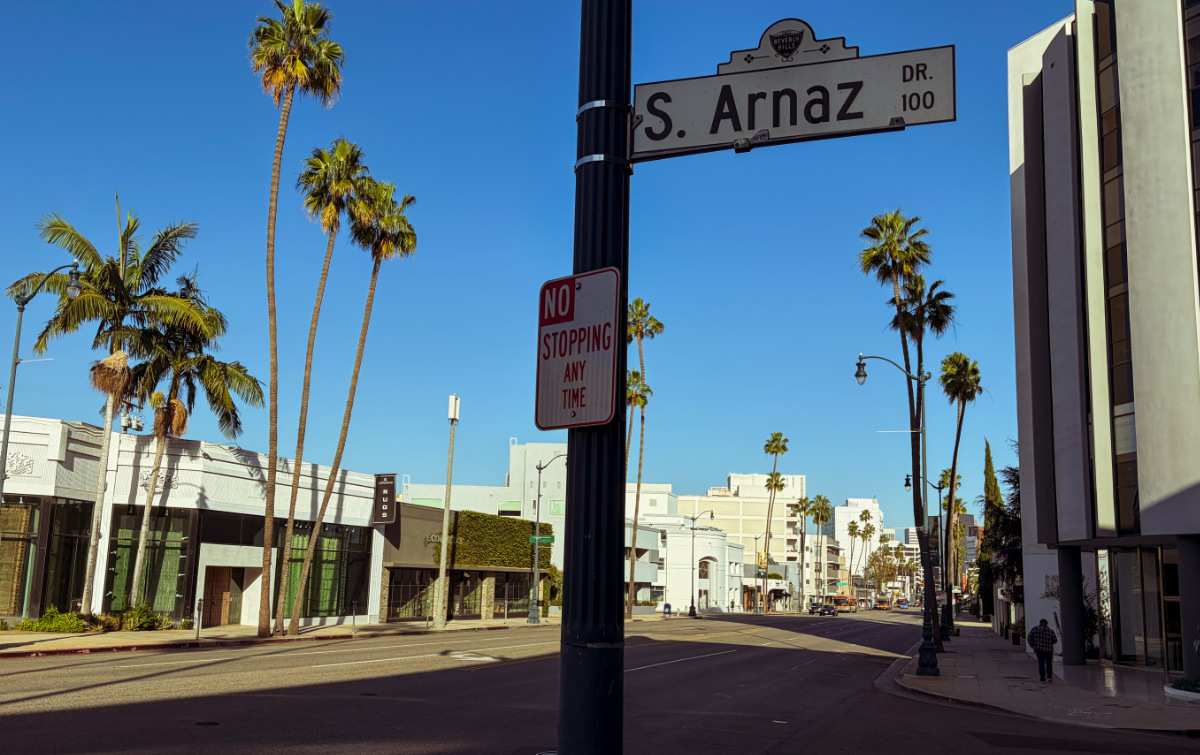
South Arnaz and Wilshire
Ten years ago, the iPhone was a perfectly fine device that was well-designed and comfortable. Somewhere along the line, though, that American idea of Bigger is Better seemed to take hold and the phones became more like mini-tablets. (I held on to my old phone for so long because it was the same size as an iPhone 6, which was nearly perfect.)
But in America, we take what we can get even—and especially—when we don’t need it. Beverly Hills is the type of city that exemplifies this idea. The palm trees, taller than most in the rest of LA, soar above Wilshire Boulevard. The showrooms for supercars that couldn’t be driven on a majority of the pothole-laden streets of Los Angeles appear sandwiched between realty estate agencies and hot yoga studios. The ostentatious houses that could reasonably house six families have two luxury cars in the driveway.
This sickening need for excess factors in at scale, from the obscene lifestyle indulgences of Beverly Hills down to the fact the smallest phones on the market are too big to fit comfortably in the hands of a grown man. The fundamentals of design are based around function, and we’ve warped that under capitalism to prioritize form, often to the detriment of everything else. Be they systems of urban infrastructure and city planning to products being of lower quality while getting more expensive, the language of constructing our physical reality has been upended by the profit motive.
God I hate going to Beverly Hills.
As a follow-up on some of my hospital thoughts, another part of my experience was actually leaving the place. I arrived around 10:00 pm on a Tuesday and left about 40 hours later. All things considered, that’s not an overly-long stay. However, as I left the parking lot and drove toward the 110—as merging on to a freeway is the most LA way to be reminded you’re back in the real world—I felt incredibly disoriented.
It’s not just that time seems to stand still, but because of the sterile and ubiquitous nature of hospital rooms, I could have been anywhere. Returning to Los Angeles felt like I’d warped into another world after spending nearly two days staring at the same off-white walls, watching repeats of Law and Order: SVU and listening to my roommate repeat the same Christian affirmations on his phone for hours on end.
There have certainly been two-day stretches where I haven’t left my apartment before, but I’m always reminded of where I am by the helicopters overhead, the cars honking from the intersection, the customers of the plumbing store loading materials into trucks in the parking lot outside my window. I can haul my laundry upstairs and have a pretty decent vantage point of Koreatown from the top. I could lie in bed for days on end and still know I’m in LA.
In the hospital, it’s different. All I hear are asynchronous beeps, all I can see out the window—if there is one—is a concrete parking garage. The news on TV reminds me that LA is out there, somewhere, having car chases and traffic jams, but from my vantage point it might as well be Mars. I didn’t realize it until I left, but I was slowly going crazy while I was stuck there.
It makes me think of everyone who has extended stays in these places, or the elderly living out their terms in the death-care equivalent. People who have no connection to the world outside of four, unchanging walls, stuck in the places the rest of us don’t have to be reminded they exist in. We have such a deformed view of what care entails in this country, and I doubt it’s going to get any better anytime soon.