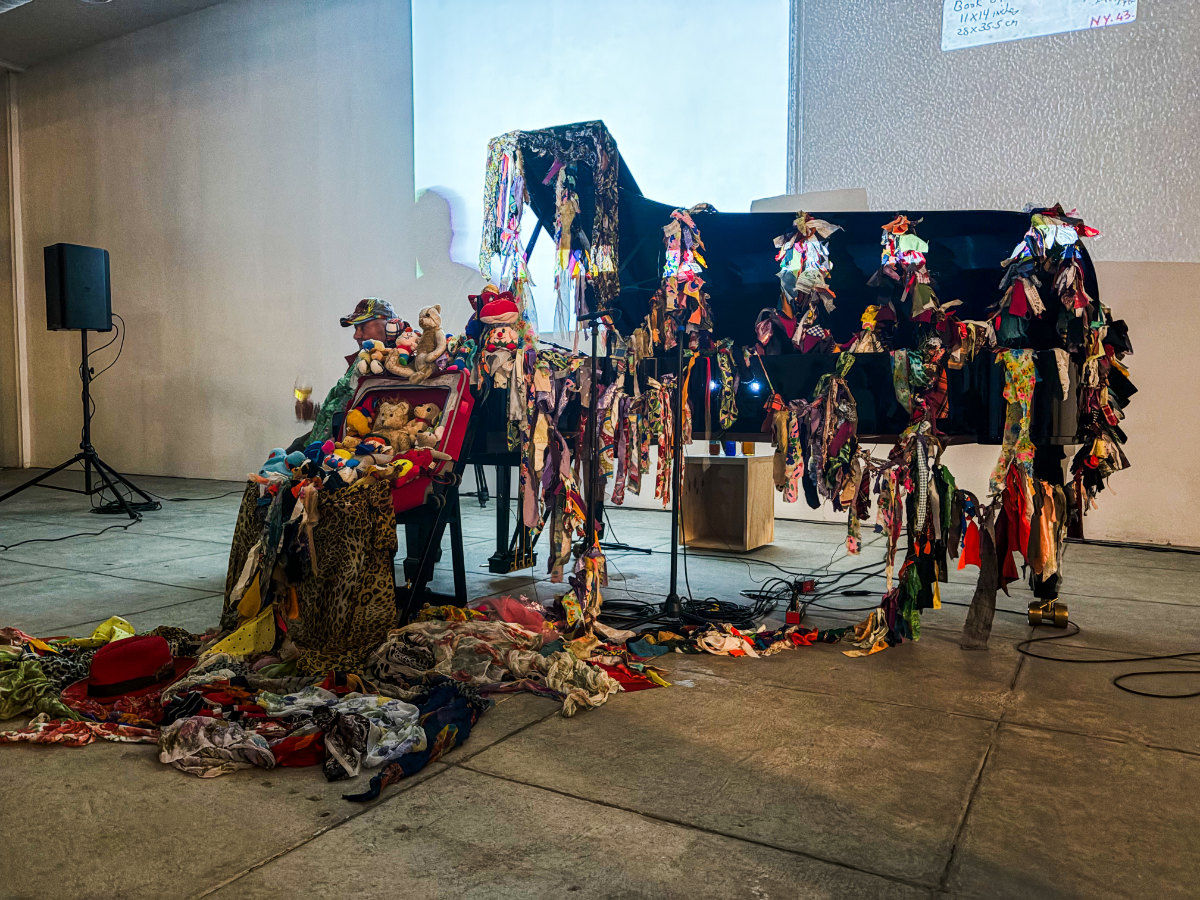
Charlamagne Palestine at The Brick Annex
Charlamagne Palestine at The Brick Annex
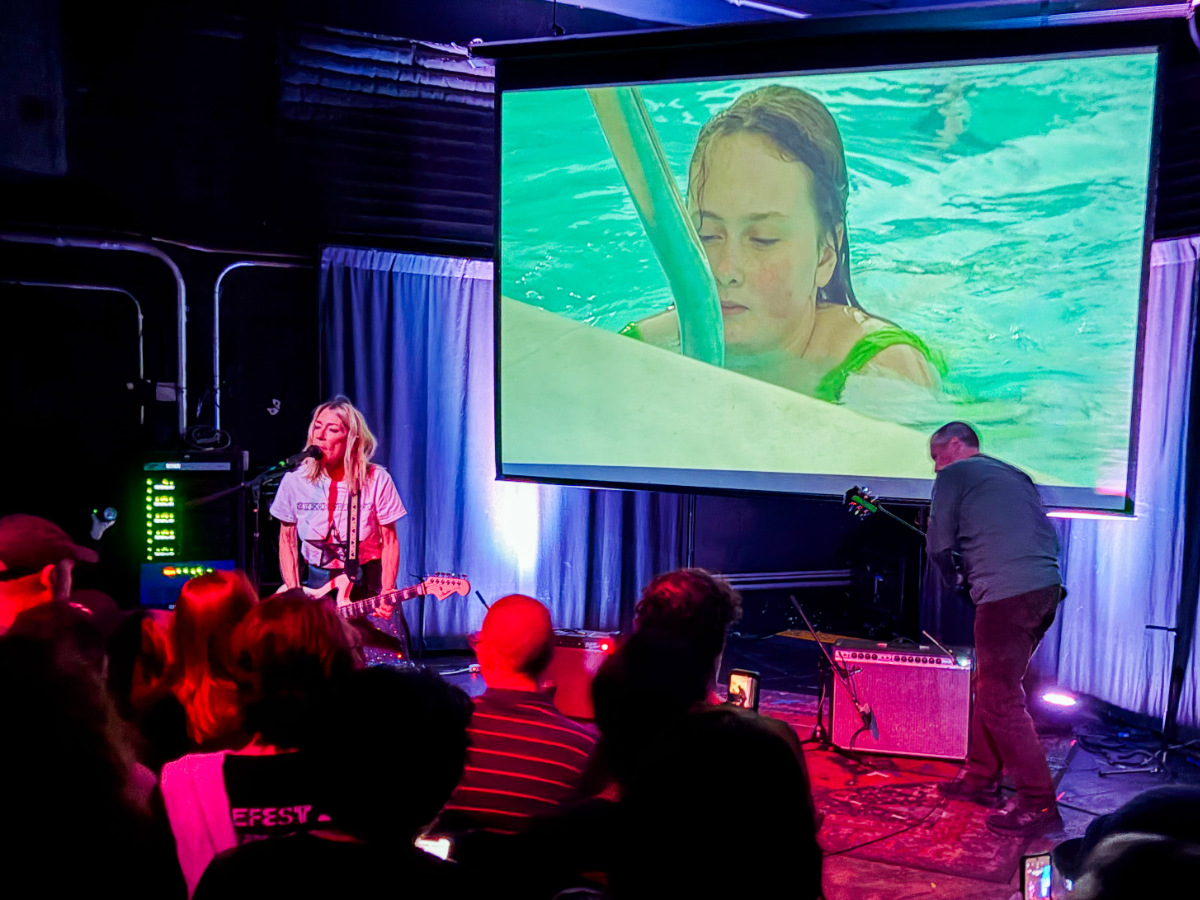
Body/Head at Zebulon
I’ve seen a couple avant-garde musical acts in the past couple days that, while sonically couldn’t be more different, seemed keyed in to the same door of utilizing sound to connect to something greater in the universe. Charlamagne Palestine used intense repetition and tonal improvisation on the piano while Body/Head was a nonstop barrage of distorted guitar with various effects layering a collage of pummeling sound.
The similarities between the two acts was striking, however. They both used long-form, anti-format performances to keep the music in the moment. Seeing your regular band at a show becomes predictable if you’re familiar with their songs—you know what parts are coming up, and they might have a slight variation, but for the most part, you’re getting a louder version of an album cut. These works were very much like, This is how the room feels right now, and there’s something inherently special about that.
It seemed very telling that the two were also helmed by musicians in their 70s. Charlamagne couldn’t even remember the year he was born when giving a brief introduction to his work. Kim Gordon is 73, although you wouldn’t know it from the noise she makes (as well as how generally youthful she appeared on stage). They are both obvious masters of their craft and respective instruments and, while giving into the moment, always seemed to have almost complete control over what was happening with the sound in the room.
Being able to walk that kind of tightrope in the arts is the type of great mastery we can all only aspire to. It’s also why, when AI executives claim making music is not enjoyable or some other bullshit, they obviously have no clue what they are talking about. These sounds were extensions of the human experience, reaching beyond what our physical bodies can feel and sense, into a place that requires a guide to go. That’s what great art is, and what the best technology will never be able to replicate.
The Pope came out against AI art this week, and that rules.
There is an ontological difference, even before an aesthetic one, between art and what a machine can generate through statistical calculation based on millions of images created by others. Algorithms lack the spark of humanity.
The thing that bothers me most about the debate around this technology is that, on multiple levels, it makes sense. Even from an evolutionary perspective, what really separates humans from the rest of the animal kingdom is our ability to think, to invent, to build. Taking the concept of passing information from one generation to the next and removing the limits of mortality from that process seems fitting—that the human species was a temporary stop on the path for the idea and utility of information to remain ever-present.
Yet these AI dorks are seriously disregarding the idea that being human can be a distinct experience that offers something technology can never replicate or replace—which is exactly why they don’t understand why people (and the Pope) hate AI ‘art.’ They simply don’t seem to understand what it means to feel connected to life at a level deeper than the aesthetic, or perhaps chemical, level. Via The New York Times:
It appeared to Rabbi Navon that [Anthropic co-founder] Mr. Olah and his team believed that Claude had what philosophers call “moral status” on par with a person — that it was a being with similar inherent rights to dignity or respect.
…
Mr. Olah was so alarmed by the pope’s strong position against A.I. consciousness that he proposed pulling Anthropic out of the event, even at that late juncture, according to a Vatican organizer.
There’s far more to that article, but what strikes me as that the concept of ‘consciousness’ they’re talking about relates purely to the idea of the AI models ‘reacting’ with perceived emotional responses to information. That because a glorified computer can represent a feeling, than it must be true. It’s absolutely fucking insane.
They also seem to believe that creativity is equivalent to the result of a prompt input as opposed to an inspired thought that can be conceived from nothing. They disregard the mystery of living in a way that resonates with the universe at an ethereal level. (It is quite ironic that their argument for AI art is purely an aesthetic and superficial one, while so much of their argument for AI as a ‘conscious being’ is that it can ‘think’ and ‘feel.’)
These people reject half of what it means to be alive—at least what it means to live outside of their understood parameters. In no way should they be trusted to helm this type of technological development at any scale. Olah claims Anthropic wants a model like Claude to be used ‘for good,’ but then promises truly evil shit like this—
Mr. Olah had begun privately telling people that A.I. was so powerful it could potentially help make bioweapons in as little as 12 or 18 months.
You cannot convince me that anyone who supports AI in the way it is currently being developed is anything less than a complete sociopath with a case of self-aggrandizement that is almost peerless in history, and is inevitably going to cause major crises when this all goes to shit (be it from a technological mishap or an economic collapse).
I’ve been thinking a lot about industrialization and how some of the modern arguments regarding AI and our current generation of change in technology amount to, Humanity has always adjusted to change. I feel like that’s a really stupid line to draw in the sand.
Yes, we’ve always ‘adapted’ and not all change is bad. The development of sewage systems, improvements in architectural engineering, the moon landing. There are so many examples in history of how innovation has spurred the next phase of civilization. But not all of it is great, and our adaptations can also distort our relationships to ourselves, to others, and to the earth.
Sometimes it’s about what we do with invention—and in the United States this is broadly affected by capitalism. Was the invention of the motor vehicle a bad thing? Absolutely not. But the national push for car culture, through the suburban sprawl and dismantling of public transit, sells more automobiles and is not publicly funded (yet it can be publicly bailed out). Cars put us in our own world while a subway brings people together, even if they’re all just reading. Car culture divides people, but it can sell a lot of units.
(This doesn’t even cover the power of the fossil fuel industries and how we’re actively destroying the planet for their economic benefit alone, and how completely fucking insane that is at a fundamental level.)

Thinking at Echo Park
Then there’s the sensory side of things. Take the evolution of how we listen to music—from vinyl records to cassette tapes to CDs to MP3s to streaming services. We lose something with each change. When cassettes hit the market, people could fast-forward through songs, although it was a bit of a pain in the ass. The arrival of the CD made it simple. Once music hit the computer, the idea of collecting albums faded. With streaming services, the idea of listening to music has completely changed since its analog beginnings.
That same ‘progress’ can be traced back with most mediums that now exist mostly on a screen, and with each we’re losing connection to the worlds of creativity, sentiment, and inspiration—and, to a degree, individual thought. Our experiences with the world are predominantly visual now—with people, places, and things. Our fundamental sensory experiences are imbalanced and so our relationship with the world is skewed. You hear it every time a friend gets back from a trip and says something like, You have to go, it’s not what you’d expect at all. Yeah, because just seeing a photograph of something tells you barely anything about it.
I really like writing letters to friends, and it’s such a meaningful act to both send and receive something made by hand. The experience is an understanding that someone took time to do something, and that creates meaning. These digital interactions have no correlation with time, and therefore we lose the sentimental relationship that underlies how people connect to one another through acts of making something.
Innovation and development are part of how we grow as a species. Humanity separated itself from the rest of the natural world with its ability to build tools. Yet for every invention we’ve used for good, there are like ten examples of profiteers pushing a harmful agenda for the sake of their bank accounts. A gun is useful if you’re hunting for food, but what have we brought upon ourselves because of it otherwise? How much have firearms been used to ruin or end lives throughout history just so a couple people could be rich?
This is why I don’t trust anyone who supports AI in the least. Could it help us cure diseases faster? Maybe. But the internet had potential to revolutionize how we run the world and instead a few psychotic narcissistic capitalists turned it into a mall of hate for their individual benefit. All of these Silicon Valley types are the same, and there’s absolutely no reason to believe that this level of development won’t be used against the people more than for them.
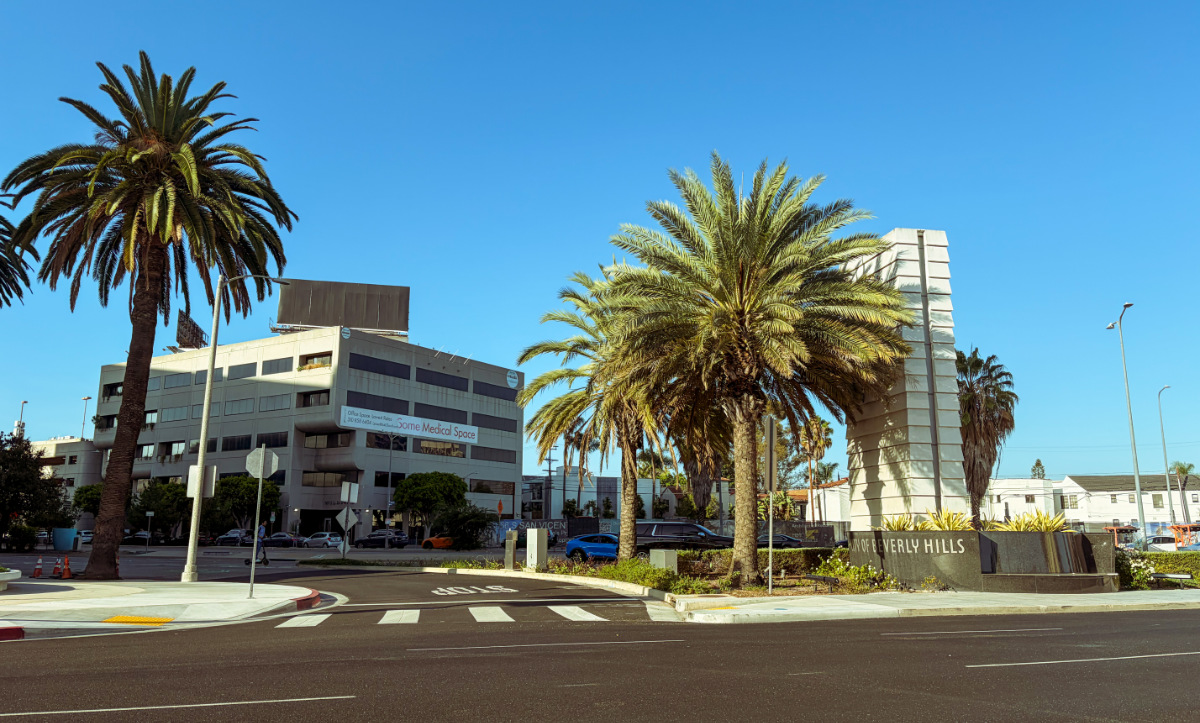
Wilshire and San Vicente
I had to get a new phone today. After years and years with my old iPhone SE, the screen cracked for the first time after I dropped it on Tuesday. The phone is so old that the repair shop didn’t have any screens in stock that would fit it. For some time now, it’s been slowly dying due to the increasing size of iOS and mobile apps, and so I took this as the final sign it was time to finally upgrade.
So I bought a new phone this afternoon. Afterward I had to go to Beverly Hills for a medical appointment, and I found myself sitting in the waiting room with some time to kill. Fiddling with this new iPhone, trying to figure out why Apple has made iOS so ugly over the past few years, I was struggling. Holding the phone along the base as I am used to, my thumb couldn’t reach the navigation buttons at the top of the screen—an action that was pretty simple on the SE. This seems like a flaw in basic functionality from a product design point of view, as my hands are a pretty decent size and should have no trouble reaching across a screen.
It felt really appropriate I was discovering this new inconvenience in Beverly Hills.
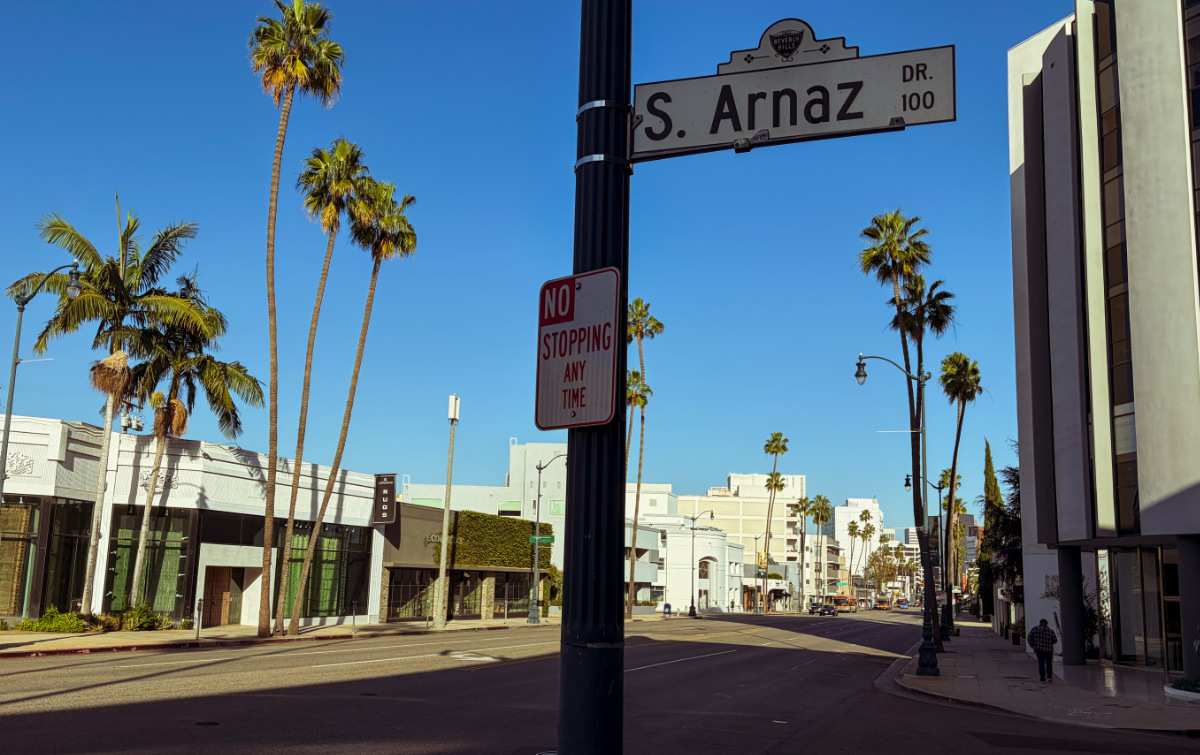
South Arnaz and Wilshire
Ten years ago, the iPhone was a perfectly fine device that was well-designed and comfortable. Somewhere along the line, though, that American idea of Bigger is Better seemed to take hold and the phones became more like mini-tablets. (I held on to my old phone for so long because it was the same size as an iPhone 6, which was nearly perfect.)
But in America, we take what we can get even—and especially—when we don’t need it. Beverly Hills is the type of city that exemplifies this idea. The palm trees, taller than most in the rest of LA, soar above Wilshire Boulevard. The showrooms for supercars that couldn’t be driven on a majority of the pothole-laden streets of Los Angeles appear sandwiched between realty estate agencies and hot yoga studios. The ostentatious houses that could reasonably house six families have two luxury cars in the driveway.
This sickening need for excess factors in at scale, from the obscene lifestyle indulgences of Beverly Hills down to the fact the smallest phones on the market are too big to fit comfortably in the hands of a grown man. The fundamentals of design are based around function, and we’ve warped that under capitalism to prioritize form, often to the detriment of everything else. Be they systems of urban infrastructure and city planning to products being of lower quality while getting more expensive, the language of constructing our physical reality has been upended by the profit motive.
God I hate going to Beverly Hills.
I tried to add an archives page to the blog a couple days ago and the entire site collapsed with the message This Website Has Encountered A Fatal Error strewn across the bottom. I’m still trying to figure out what I did wrong. One of the hurdles I have is a lot has changed since I learned to code and build out WordPress themes back when it was still a new thing. Most now isn’t even code-based, and the parts that are require an industry-level knowledge base to understand.
Beyond just being an inconvenience to dig up pages that actually have the code and examples I’m looking for to build out pages with, it just kind of makes me feel bad about the internet. There used to be something incredibly fun and rewarding about spending an afternoon—because, really, that’s all it took in the days of simple HTML sites—making a personal web page.
Reflecting
These days, we live in the age where everything fails after a couple years. Smart phones, appliances, cars. Nothing is built to last. We can look at old furniture, hand-built by craftsmen, and admire its longevity and attention to detail. When I was growing up, I remember companies still offered lifetime guarantees on what they sold. Somewhere along the line, that all stopped. That’s kind of a parallel to what I imagine the not-too-distant future will be like for people online, surrounded by social media AI slop, where nothing is real and no voice is authentic, wondering what the early days of the internet were like.
There’s a purity and connection created between a person and an object when something is done by hand. It’s a kind of transference of humanity to an object. The combination of technology, capitalism, and trade expansion has always disrupted the processes of personalized building. From log cabins to the suburban sprawl, from loom-spun sweaters to fast fashion sweatshops, from painted portraits to the photograph to AI slop—we’re always in a state of ‘progress,’ yet simultaneously lamenting the fact the objects that inhabit our lives were always better back in the day.
Nothing is ever better because it becomes automated. It just becomes more convenient. It’s justified to the masses by way of ‘consumer savings,’ yet the harm comes in the form of disrupting community businesses with box stores, with individual creative designs replaced by templates, with personal interactions turning into people consulting AI bots about their lives. Industrialization has been a slow burn and the jump to what comes next has been a long time coming, but it’s almost here and I don’t think people are prepared for how this is going to alter the very nature of what it means to be human. It’s just so sad.