all in

It’s the best time of the calendar year for sports: we’re in the meat of the World Series, both college and professional football are in full swing, and the NBA season has officially begun. There’s no shortage of something to see on TV if you’re into the general idea of, well, anything sport-related.

However, now that means you see more gambling ads than ever. The NBA just announced an official partnership with two major ‘prediction market’ apps. (Prediction market has to be the dumbest ‘just make sure we don’t call it gambling’ workaround ever.)

Even if there weren’t so many disgusting celebrity-packed advertisements for this shit, and even if every broadcast of any sporting event wasn’t filled with sponsored, real-time betting lines, the fact remains that gambling addiction is a real thing that is being treated like nothing at all. The media in the United States has laws in regards to marketing alcohol and cigarettes, but when it comes to gambling, it’s not only unregulated, but these companies are allowed to sponsor sporting events that people bet on.

I don’t know anyone who likes sports who supports any of this—most people I talk to find it all infuriating. But I do feel for the people who have a gambling problem out there, because this can’t be easy. I know a guy who goes to GA (Gamblers Anonymous) and watched him go through a six-month relapse a couple years ago. Every day it was hours and hours at the tables, up thousands, down thousands, wild swings of financial fortune and loss in rapid succession.

It just feels like these companies are counting on people like this, waiting to take their money, regardless of the consequences, and the leagues and broadcast networks are all-in.

too soon

Santa Claus is coming to town. At The Home Depot, save up on getting ready for the season …

That’s all I heard. It was 11:32 PM, I was driving on the 110 and the first ad for the Christmas season was on the radio. In the span of ten seconds, I checked the time, tried to clock the date (at first I couldn’t remember if it was still September because this was so surreal), and, after waiting to see if this was actually a real ad and not just some late-night joke by a DJ, I changed the station immediately.

I don’t even know what to write about this. Just that it’s October 10 and to be hearing Christmas promotions on the radio—for Home Depot, no less?—just feels wrong. I couldn’t tell you why. Maybe it’s because this feels like further evidence that nothing really matters anymore. All of life in the US has just become some sliver of existence between an advertisement and abject violence. And Christmas, apparently.

american idiots

I don’t care much about Trump’s speech where he riffed on Iran ‘taking out’ Los Angeles and San Diego. Like, whatever. Guy says more egregious things in a week than most politicians do in their entire career. Anyone surprised or offended must live under a rock. What is kind of funny to me is just the people who cheered in the crowd.

The speech took place in Nebraska, where earlier this year over 2,000 people climbed some stairs to honor the 25th anniversary of the September 11th attacks. It’s just one of those things that goes to show how absolutely warped the red-state perspective is. Like, nothing on 9/11 affected fucking Nebraska.

So many of the people in these places will say bullshit like Never Forget while, in their next breath, hoping that some ‘liberal’ city gets wiped off the map. It’s a weird, fake patriotism where political morality adjusts to whatever point they’re trying to make (or support) in the moment. It’s the epitome of spineless American stupidity, so no wonder these people support a guy like Donald Trump.

the frogs

These days I’ve been thinking about the boiling frog.

The boiling frog is an apologue describing a frog being slowly boiled alive. The premise is that if a frog is put suddenly into boiling water, it will jump out, but if the frog is put in tepid water which is then brought to a boil slowly, it will not perceive the danger and will be cooked to death. The story is often used as a metaphor for the inability or unwillingness of people to react to or be aware of sinister threats that arise gradually rather than suddenly.

Obviously this can be used as a metaphor for power and greed, which I think the United States is a prime example of in its 45-year decline since Reagan took office and conservatism has chipped away at just about everything that was beneficial to the people at large. Today, though, I’m thinking about it in a more literal sense.

Los Angeles is currently being hit with its third heat wave this summer. Usually in LA, the season is certainly on the warmer side, generally ranging between 80 and 90 degrees Fahrenheit with a few days that reach the hundreds. This year we’ve had three separate occasions where week-long heat waves where the low temperature would be 95 and even the middle of the night will be 80. While this is also a side effect of the Super El Niño going on, it certainly raises some eyebrows when it comes to climate change.

At this point it’s deadly obvious the United States has no interest in preparing for the possibly apocalyptic levels of displacement and death that could occur over the next 20-50 years. It’s not like the wealthy would care—they will most likely profit in air-conditioned offices and afford to avoid any catastrophes, and if a substantial amount of the population dies off, that means the remaining resources on Earth are proportionally larger. And they certainly don’t care about animals.)

While we’ve been the frog in the pot metaphorically for some time, now it seems like we’re in the literal phase. The climate is going to get more extreme, but not all at once. It’s just going to get slowly worse, with a few more deaths every year, until it’s far too late. Those in power will throw up their hands and say, “There’s nothing we can do about it now, you’re all on your own.” The domino effect of social deterioration will accelerate and there’s a decent chance Mad Max: Fury Road is retroactively seen as some kind of prophecy.

And the only way out of the pot is through wealth—and who knows how long that will really extend your life with the possible consequences of this looming crisis.

the malls of america

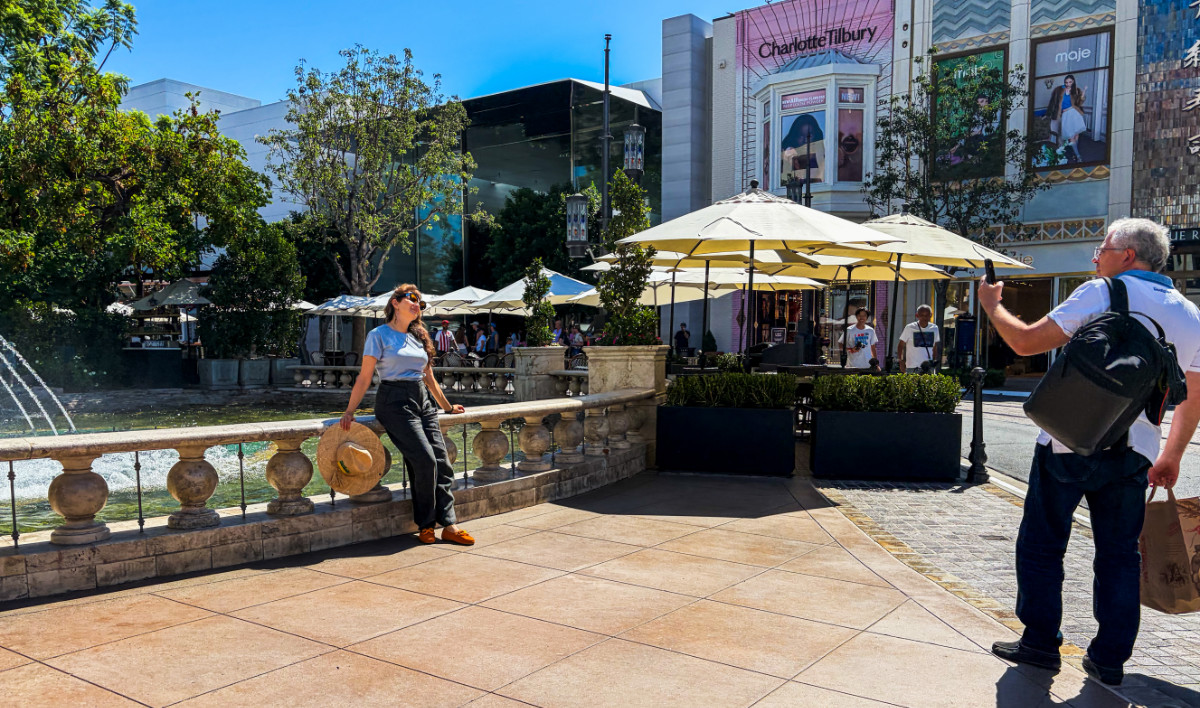
I hate The Grove. It’s one of two gaudy, outdoor malls in Los Angeles by a billionaire who lost the race for mayor four years ago (the other being The Americana). In the past, I’ve found myself at the latter to catch a movie in the middle of the day because it’s down the street from my mechanic and I’d need to kill a couple hours while my car was in the shop. The Grove, though, I avoided at all costs.

Now, I can’t. At least not if I want to see a new movie.

Since theaters re-opened in 2021 or 2022, I’ve been using AMC’s A-List membership. I see a shit-ton of movies and the cost pays for itself if I go just twice a month. However, I’ve also lived in East Hollywood that whole time—just a 12-minute drive from the Burbank multiplex with its 30 screens and free parking.

A couple months ago, I moved into what is basically my dream place. There’s really nothing to complain about—except now that I’m in Westlake, Burbank is a much further drive and now the closest AMC theater is at The Grove, with its 14 screens and $6 parking.

The Grove

An afternoon at The Grove

There are any number of reasons I hate this place. An outpost of capitalism, there’s a kind of faux classiness to it all. There are ‘luxury’ stores but the experience of being at one of these malls is anything but. It’s the shopping center version of pleather. (Kind of ironic given Rodeo Drive is just three miles west, down Third to Beverly Hills.)

One thing going to The Grove does for me though, is that it reminds me how different people can be. It’s a real removal from my comfort zone. I walk around completely confused as to how people of all ages go to this place willingly and un-ironically, just to like, hang out. It is mystifying.

Consumerism in America is so central to national identity that places like The Grove really make me think about how the notion of what you want at a material level seeps in to every aspect of life—how being presented with certain options is disguised as being catered to, and what that means for how we view our politics. These sorts of places use the model of collective gathering to spur on the notion of individualism, and I think that’s far more destructive to the human condition of living in the United States than the specific economic model of capitalism (though the two are inextricably linked).