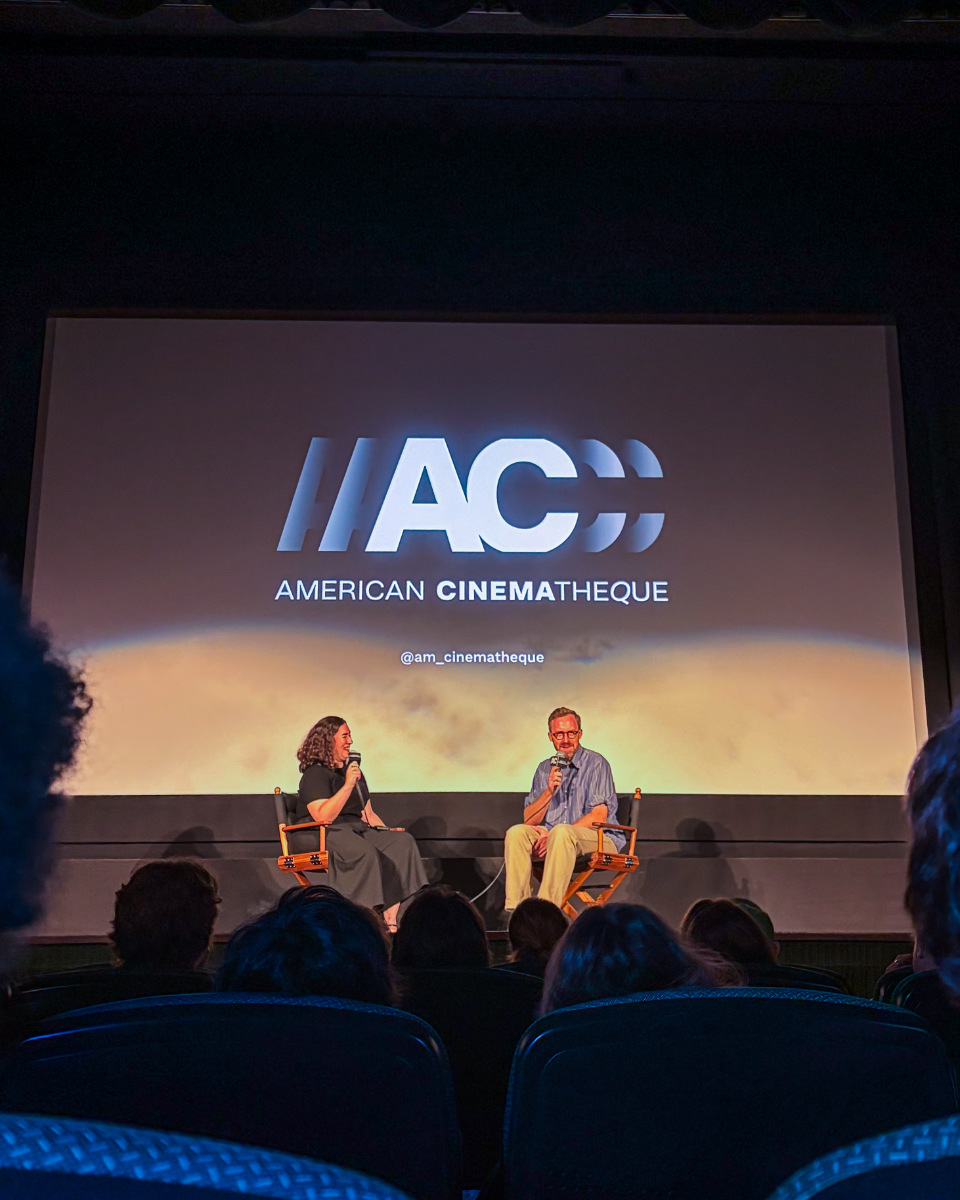
Q+A with John Wilson
Q+A with John Wilson
Had the opportunity last night to see an advance screening of The History of Concrete featuring a brief Q&A session with John Wilson afterward. I’ve written before about what a joy theatrical experiences are in Los Angeles, and this certainly was no different. Waiting in line outside the theater beforehand, a guy drove by yelling, “Fuck yeah John Wilson!” out his window. A Gen-Z woman on the corner waiting for some tacos yelled toward us, “I’m jealous of every single person waiting in that line.” It was a good vibe.
Some would argue that the weather and the water are what makes living in LA worth the steep cost of living. Some might say that there’s a lot of opportunity. Some would say there’s just a lot going on. None would be wrong. It’s so expansive, both literally and metaphorically, that you can really just take what you want and leave the rest. While it’s probably nice to be a movie star and live in such a place without having to care about gas prices, the city offers up plenty for people who aren’t in the one percent. It’s still a good place to just be.
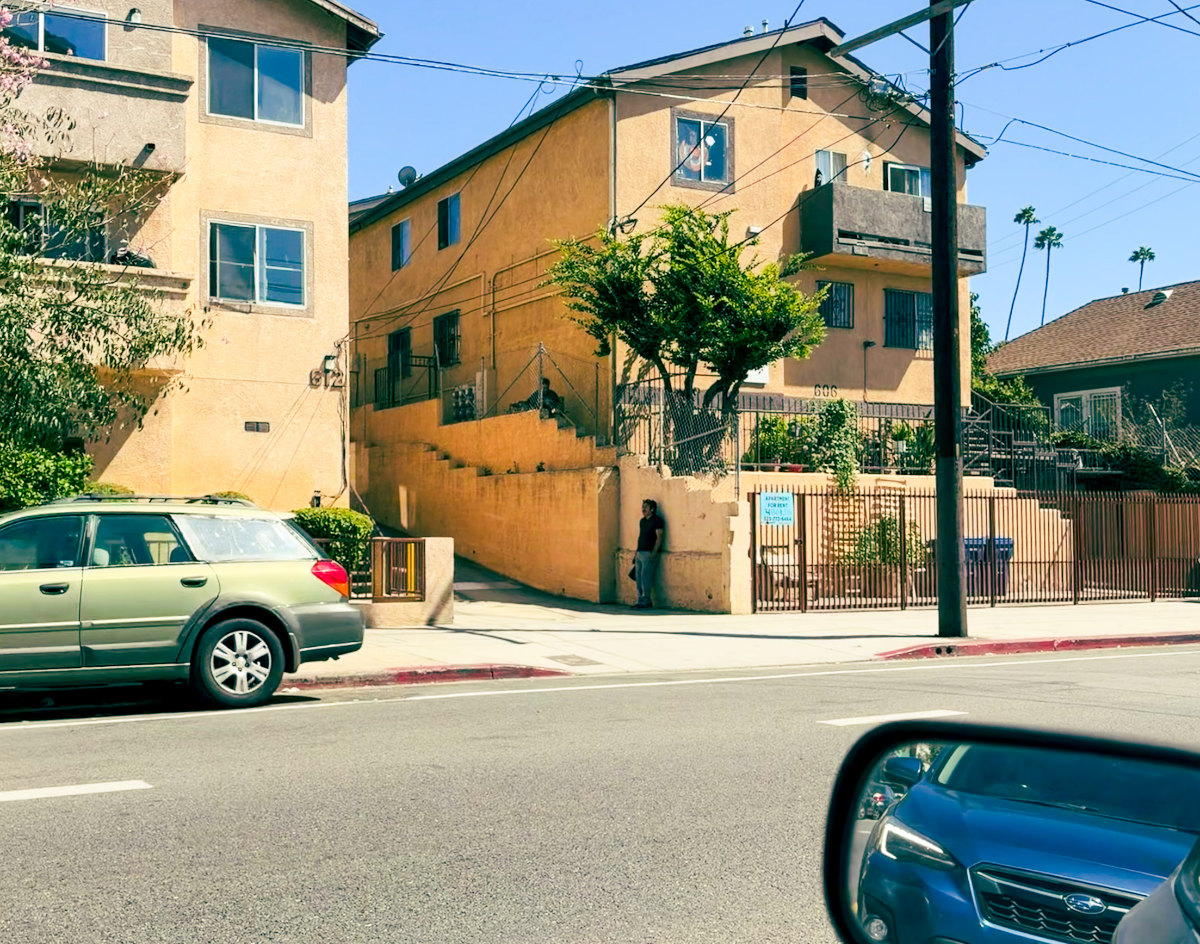
Alone in Virgil Village
Yet gas prices are a concern for many. There are more than a couple crises facing the city right now being debated in the lingering mayoral election (go Nithya). But the larger, national issues that a mayor has no power over are hitting hard here.
I was driving down Virgil and passed a Sinclair gas station with a line into the street of waiting cars because they were selling gas for $5.79 a gallon—which is the cheapest I’ve seen in the past few weeks. As the threads of the economy are being pulled apart by profiteers everywhere, I kind of wonder how this will play out in such a sprawling, only-kind-of-interconnected metropolis with an outsized police budget.
It does feel like we’re in the last moments of musical chairs, except there are like two chairs and three hundred people trying to grab a seat. There’s no telling what chaos will ensue when the dominoes start to fall at scale, and it’ll probably hit different everywhere. A city like San Francisco, condensed and contained by geography, will respond to public discontent with measures that won’t work in LA’s sprawl. That discontent will be difficult to measure as well, because class solidarity doesn’t really begin to take hold until a large majority of people can’t afford to just be where they’re at.
So I’m trying to enjoy these fun little movie screenings while I can, because it certainly feels like this is all going really bad and is going to get much worse in the not-too-distant future, and I have no clue what living in a city like Los Angeles is going to be like if gas hits ten bucks a gallon and all the restaurants shutter, but I can’t imagine it will be the fun kind of vibe I enjoyed last night.
Speaking at the World Economic Forum, New York Times financial columnist Andrew Ross Sorkin imagined a future where only wealthy people would be able to travel and ‘those of lesser means’ would only be able to experience the world through a VR headset. He goes on to talk about how that might create a divide between rich and poor. Jesus Christ.
It’s quite obvious how the chess pieces of technology, corporations, capital, violence, and governance are being aligned right now to create a future where the majority are ruled with a generally automated iron fist by the few. It’s the plot of endless sci-fi stories, but what comes to mind is Elysium, where the rich build themselves a giant space station as the rest suffer on a burning Earth patrolled by robots. What’s also evident is that those who aren’t quite wealthy, but live comfortably above most, are generally in favor of this divide, even though it would likely see them stuck holding the short end of the stick with the rest (see: Ross Sorkin and the entire NYT op-ed section).
There’s a good chance it is too late to do anything about it. While groups of people who lean left politically exist in the United States, they’re predominantly in urban areas and proportionally tiny compared to the population at large—a population that believes capitalist neoliberalism is ‘left-wing.’ The type of change required to do anything about wealth disparity—via reform or revolution—is simply impossible. In turn, the country will be forced to look on as the people are robbed, their food supply poisoned (or, eventually, lost), and any reaction brutally policed by stalkers and thugs using AI surveillance. (Even at the local level, despite outrage from the people who elected them, city councils are voting in favor of building data centers everywhere.)
Meanwhile, the wealthy and their fans will go on to have discussions about how they’ll be perceived as all of this violence against humankind continues unpunished. The United States has probably passed any point of anyone in power having to deal with any kind of consequence for any action whatsoever. We can’t even properly handle cops standing around for hours during a mass school shooting, much less force the release of the Epstein Files. This country has volunteered itself into submission.
China might be able to reframe the balance of power in the world and possibly diminish the role of capitalism in the future, but the United States will surely burn itself to the ground—and as much of the world as possible—before that happens.
I spent some time last week at LACMA with Christian Marclay’s The Clock—which I’ll write more about after tonight when I spend as much time as possible at the 24-hour screening—and was consistently annoyed by how many people felt perfectly fine to maintain ongoing conversations or take their phones out to text someone in the theater. But, much like most third spaces these days, art museums are not immune to the degrading notion of the social contract.
Since movie theaters re-opened after Covid-19 restrictions were lifted, I’d say about one-third of the films I see have had someone take out a phone for one reason or another during the show. (I will say most of these happen at AMC chain theaters.) This ranges from taking a photo of the screen (mostly the title card) to texting to scrolling a dating app or Instagram. I’ll always react in some ways—a glance to asking politely to saying, Turn your phone off aloud. The responses I get have varied from being ignored to having people tell me to fuck off.
(I was at the AMC Burbank 16 for a movie once and the guy next to me asked a woman in front of him who had been texting for five minutes straight to please put her phone away and she turned around and replied, “You talked all during the previews so why don’t you kiss my ass.” Absolutely bonkers response.)
These aren’t limited to corporate screenings, though. While it’s far less frequent than what happens at a chain like AMC, I’ve seen phones out at screenings for American Cinematheque or even Tarantino’s notoriously anti-phone theaters (the New Beverly and Vista). These people risk being kicked out, or even banned, from theaters just to check their Twitter feed.
Now, part of this could be just screen addiction and the fact humanity seems to have been consumed by an inability to leave the digital world for any meaningful amount of time. But I think one of the consequences of how Covid was both handled and politicized is that the country became divided on whether or not it really gave a shit about anyone else at an individual level. (We know now that any excuses about masks were bullshit as we see ICE agents and cops masked up all the time for their thuggish actions and that the entire conservative and fascist side of the population doesn’t have any central ideology other than to ‘win’ at whatever talking points are dominating the news at any given time.)
The increasing individualism that has been chipping away at how we treat others in social spaces, whatever the root causes may be, are reflective of a growing resentment toward one another while the country we share continues to decay in a storm of corruption, greed, and outright lies by those in positions of power. This is all by design, and sometimes I just want to escape the madness by going to the movies, and now there’s a constant reminder of what is happening in society as a whole.
We’re having a mayoral election in LA this year and like most of the political world right now, it’s incredibly stupid. It’s another of those popular races that take up the news these days—a progressive democratic socialist, Nithya Raman, against an establishment liberal incumbent, Karen Bass. The establishment does not like this (surprise, surprise). Meanwhile, every time there’s news about this thing, I want to slam my head into the wall in disbelief that Raman isn’t running away with it.
Just today, Bass came out in favor of the potential merger between Paramount and Warner Brothers, even though just yesterday it was reported that the merger would cost Los Angeles over 10,000 total jobs between entertainment and the businesses it supports—around $2.8 billion in the local economy, gone. The Writers Guild immediately issued a statement tearing Bass apart.
There was also a kind of insane warehouse fire in Boyle Heights this year that saw no city declarations for evacuation—only Bass, who spent the first two days of the fire out of the city, telling residents the air was not dangerous. (That ‘safe’ air caused hundreds to suffer health affects directly from exposure.)
Of course, this is all after Bass botched her oversight of the wildfires that burned the Palisades and Altadena to the ground in January of 2025. Los Angeles has also seen cuts to city service budgets in order to give the LAPD more cash. (The LAPD already had an annual budget of over three billion dollars.)
While the criticism could continue, the point is this: All over the United States, in governments local and national alike, establishment democrats are being called out for their decades of stalled policy, lack of ambition, and corporate interests being prioritized over serving the public. What makes me crazy is that the general public is somewhere between fearful of and hateful toward the label of socialism, even if policies like upgrading infrastructure or improving conditions for schools are wildly popular.
Red Scare tactics have proven very successful in the United States, where even ‘liberal’ cities like LA have a substantial population that doesn’t want to lean too far to the left. (What that political ideology actually looks like is beyond me—but I’m pretty sure it’s more in alignment with fascism than humanism.) As conditions continue to rapidly decay while wealth consolidates in the hands of a few, I wonder at what point people will come around to the idea of listening to voices from the left—or if by that time there’ll be anything left to actually govern.
There’s an interesting parallel between the rise of guys like Elon Musk, the Trump presidency, and the simultaneous adoption of and enthusiasm behind AI—it’s the dawn of a new era of the con.
Whether it was Lee or Bernays who created modern day public relations doesn’t matter so much as the effect they’ve had on the world because of it. Advertising is one thing, but the idea of PR and manipulating social dialogues around everything—as opposed to just products or investments—has brought us all to this era of un-reality in the west.
Taking a look at Musk, for all who laud him, he has not actually built anything. He doesn’t know anything about cars or rockets, he purchased the assets that have built his wealth (or built them on government subsidies while being ‘anti-socialism’). He’s no inventor, shows no capacity for innovation or vision for the future. He’s just a shrewd capitalist (and a pretty big fucking idiot). Trump may have made some real estate dealings in the past but is notorious for fucking over workers (as well as lying about, well, more than I can link to). These are men who keep their heads above water because of how American culture has adopted public relations on the thoroughfare of public debate.
Yet these men are lauded by many for their ‘leadership.’ Wealth supersedes any questions in relation to morality, justice, equality, or even legality. It’s repugnant.
Somewhere along the line, the idea of what you make of yourself became less important than how what you make of yourself represents the capitalist ideal. Social intangibles like respect and dignity and honor have long evaporated from the air we now collectively breathe, and everything is about money and power. Being a shitty person has a proportional relationship to how much money you have at your disposal to ride out any negative news cycle that might carry your name with it. Do we really think Mark Zuckerberg will be affected by the fact his superyacht didn’t help a boat in need?
And so a new age of deceit is upon us. It’s no wonder that the people largely associated with these ideas also adopt AI so completely—to them, cutting corners for financial reasons is more important than any natural, human process. Art does not matter to these people—creation is an inconvenient step in the process of financial viability. Existence, and its potential, are secondary concerns to capital gains.
The MBA idea that everything is business has overwhelmed our relationship with inspiration. Labor is no longer about meaning something, it’s about cost-effectiveness. These people have adopted the idea that financial equations are more important than human endeavors, and so aesthetic (or any constructed) results that suit any need of production are more important than creative processes.
This is a cancer upon humanity. I’m not saying that every use of AI is bad, or that every statement to the media is a lie, or that every businessman is a crook. But we have entered an era where the potential truth of the internet has been consumed by the dishonest nature of advertising—and along with it, those who profit are becoming shells of human beings who are only icons of wealth, shedding all other traits in regards to empathy, kindness, dignity, respect, or honor. They are the scum of the earth infecting growing swaths of the population with this grotesque self-centered outlook that defeats the purpose of our collective existence.
Capitalism is beyond an economic crime, it is the death knell of what makes people a part of the natural world. With the technological advancements we’re developing now, if it remains as influential as it has been over the past couple centuries, we are certainly doomed to lose a majority of our civilization to completely inhuman ways of being.