guilty pleasures

(Like everyone else, I review the films I see on Letterboxd, but I write about movies as a general idea here.)

Zach Cregger has made a Resident Evil movie and it looks awesome. I’m a big fan of both Barbarian and Weapons and have always enjoyed the games when I’ve played them, so I’m pretty stoked on this. Will it win Best Picture? No. Will it be fun as hell? Probably.

Here’s the kicker, though: I love Resident Evil. I don’t mean the IP or any of the specific games. I mean the original movie from 2002 starring Milla Jovovich. I enjoy all of its 100-minute runtime. I can totally admit it’s 100% a bad movie. It’s a bad script with terrible acting and some really awful special effects. Yet still, I love it. It’s a guilty pleasure.

There’s been online discourse of late saying there’s ‘no such thing‘ as a guilty pleasure, or we need to take away the shame of it. (NPR even took a look at the brain science behind the concept.) I would argue the middle ground is where we should land as a society—yes, there are guilty pleasures, but we should also not fear any kind of public shame for indulging in them.

The innocence of guilt

I think a person should be proud to admit they have a guilty pleasure in art or culture because at least they’re admitting to understanding the idea that there are echelons of these things produced in terms of meaning and substance. If you say a Marvel movie is a guilty pleasure, you’re admitting you understand that it’s corporate franchise slop written at a fifth-grade level designed for nothing more than a dopamine rush, but you just don’t care. And that’s fine. It’s the understanding that matters.

I’m not always watching arthouse films. Hell, Bad Boys II is a piece of capitalist copganda and I love the shit out of it. But I know that Michael Bay wasn’t setting out to ask societal questions when he had Will Smith dodging boats in a Ferrari while speeding across a Miami bridge. He just wanted to throw boats at a car on a freeway.

However, I can say that movie, or Resident Evil, is a guilty pleasure because I know there are arthouse movies out there that Ask Serious Questions About Life, that exist because a filmmaker wanted to make us leave a theater with a new thought or idea about the world around us. I know that, while entertainment can be fun and relaxing, art and the concepts that creatives process during crafting a film or writing a novel is where we actually discover things about our humanity. Any moral quandary posed by a Marvel movie has been vetted by the CIA, while a David Lynch film will leave a person wondering what morality originates from.

Go for it

I have a friend here who is a very good, serious artist. I was at her place once staring at this massive painting of a tree she had splayed out across the floor of her entire apartment. In the corner, her television showed one of her streaming accounts and all of the ‘Recently Played’ section was filled with episodes of one reality show or another. I asked about it and she proudly said she loved it all—she could work with them on in the background, not having to worry about her attention being distracted by something heavy or some plot point she had to pay attention to. Also, they were just entertaining. It made sense.

She and I both know plenty about Serious Art, but also that there’s plenty of reasonable occasions to indulge in whatever bullshit might exist for the sole purpose of vapid entertainment. I tend to think the issue of American culture is that we’re increasingly being pushed in the direction of that void of uncaring, incompetent slop. Stephen Spielberg and John Williams teamed up to create one of the most iconic films ever made in Jurassic Park, which is now just a recurring CGI-fest of absurdity and nonsensical plot lines. Our entertainment is getting dumber, and our society is culturally worse for it.

I think the danger of a guilty pleasure lies in not knowing that it is one, or why it is one. To not understand that the new Avengers movie and Zodiac might both star Robert Downey Jr but the latter is a significantly different type of film is a kind of cultural illiteracy that I think we’ve generally waded into as a society, and instead of trying to right that wrong, we’re trying to take away any stigma about the shame of preference—even though that preference is nothing to be guilty about, but understanding the holistic nature of why culture matters to humanity is an inherently important and valuable part of life experience.

racing in different directions

We’re having a mayoral election in LA this year and like most of the political world right now, it’s incredibly stupid. It’s another of those popular races that take up the news these days—a progressive democratic socialist, Nithya Raman, against an establishment liberal incumbent, Karen Bass. The establishment does not like this (surprise, surprise). Meanwhile, every time there’s news about this thing, I want to slam my head into the wall in disbelief that Raman isn’t running away with it.

Just today, Bass came out in favor of the potential merger between Paramount and Warner Brothers, even though just yesterday it was reported that the merger would cost Los Angeles over 10,000 total jobs between entertainment and the businesses it supports—around $2.8 billion in the local economy, gone. The Writers Guild immediately issued a statement tearing Bass apart.

There was also a kind of insane warehouse fire in Boyle Heights this year that saw no city declarations for evacuation—only Bass, who spent the first two days of the fire out of the city, telling residents the air was not dangerous. (That ‘safe’ air caused hundreds to suffer health affects directly from exposure.)

Of course, this is all after Bass botched her oversight of the wildfires that burned the Palisades and Altadena to the ground in January of 2025. Los Angeles has also seen cuts to city service budgets in order to give the LAPD more cash. (The LAPD already had an annual budget of over three billion dollars.)

While the criticism could continue, the point is this: All over the United States, in governments local and national alike, establishment democrats are being called out for their decades of stalled policy, lack of ambition, and corporate interests being prioritized over serving the public. What makes me crazy is that the general public is somewhere between fearful of and hateful toward the label of socialism, even if policies like upgrading infrastructure or improving conditions for schools are wildly popular.

Red Scare tactics have proven very successful in the United States, where even ‘liberal’ cities like LA have a substantial population that doesn’t want to lean too far to the left. (What that political ideology actually looks like is beyond me—but I’m pretty sure it’s more in alignment with fascism than humanism.) As conditions continue to rapidly decay while wealth consolidates in the hands of a few, I wonder at what point people will come around to the idea of listening to voices from the left—or if by that time there’ll be anything left to actually govern.

basquiat never graduated from high school

I’ve been to a few art openings recently and I’ve noticed this trend of oversized, low-resolution digital works that were basically just slapped together in Photoshop, printed and hung on name-brand gallery walls. They were aesthetically awful, but came with a multi-page artist statement full of buzz words.

There’s a problem in contemporary art where artist statements become the main focus of a work. Intention and the ability to communicate in a language style that represents intellectualized considerations seems to matter more than how a work actually looks. I’m not trying to advocate for style over substance, but this growing pattern where what someone writes about art against what they actually produce feels like it’s buying in to the capitalist ideology of a class-based society.

I was at a group show last week that was selling the booklet of artist statements for $15, which I thought was crazy. I like conceptual art and there’s certainly plenty of great work in the world produced from it, but I also think that using the concept as a basis for actually showing work is prioritizing the wrong side of the coin.

Yes, everyone has different tastes and there should be an opportunity for every idea to be on display, but it feels increasingly like there’s this undercurrent of MFA-types who are getting away with spending more time indulging in navel gazing than working through the trials of process that end up producing aesthetically pleasing work. (If something being aesthetically repulsive is part of the concept, then that’s fine, but if you simply won’t spend the time to try and make something and just paste bullshit together, that seems cheap.)

It just feels like some artists try to convey they went to an MFA program through how they talk about their work, which buys into the idea you need to go through the institution of higher education to become a gallery artist. It’s very reflective of how a caste system works and I think that should have nothing to do with art. Writing about a piece of art is a fine addendum, but the work should be able to speak for itself.

adding to the shelf

Books

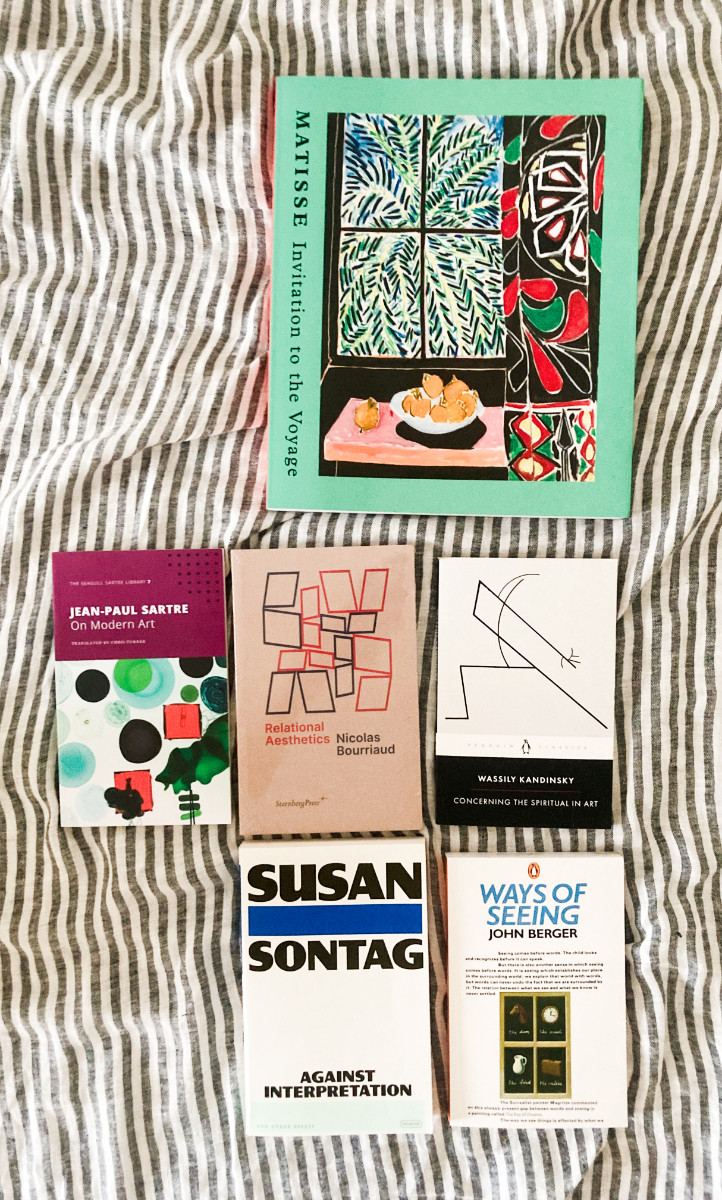
Today’s haul from Stories

entertaining the idea of art

Man, Emily Wilson sure took Chris Nolan and The Odyssey to task in her review and I am all for it. If you’ve seen the film, the entire piece is worth reading—but the conclusion really brings her point home:

Nolan’s Odyssey lacks many of the elements that make the poem great. It has nothing convincing to say about time, memory, history, war, or about the relationship between one warrior’s glorious return and the lives of his family, adversaries, comrades, friends and neighbours. It lacks psychological, emotional, political and ethical depth. Its narrative structure is gimmicky. The writing is abysmal. None of the characters has convincing motivation for their actions or words. There are no sex scenes, and all the food looks horrible.

The most troubling ethical problem with Nolan’s Odyssey concerns the decision to film part of the movie in the occupied territory of Western Sahara, thus normalising the ongoing violence against the indigenous Sahrawi people. It is particularly galling that Nolan used this land simply as a visually striking backdrop for a film that centres, aggrandises and redeems the hero of a territorial war on account of his belated and partial acknowledgment of his own guilt.

For far too long, Chris Nolan has been relatively immune to criticism for reasons unknown. Perhaps it’s the striking imagery he’s been able to create—the black hole in Interstellar, the folding cities of Inception, the bomb in Oppenheimer—or maybe it’s that a couple performances have been Oscar-worthy (I would say Heath Ledger in The Dark Knight is the only truly great performance in a film of his, though). Whatever the reasoning, he’s considered critically by many journalists and social media cinephiles alike as one of the premier directors of this generation and I am absolutely dumbfounded as to why (I find Interstellar and Oppenheimer both to be as overrated as The Odyssey).

Good writing is the foundation of any cinematic achievement and none of Nolan’s films have had an above-average script. Worse still is his direction of conversational dialogue, which is often choppy on top of being drowned out by sound design that favors background environments and nonstop scores. His female characters are often hollow and disposable (and even the men are largely one-dimensional). He excels in aesthetic scale but consistently fails to deliver on any emotional, human level. It raises the questions: What are modern audiences looking for in a film, anyway? Why are these movies considered among the best of our time?

I can’t help but think this is less about Nolan being a bad director than it is more a sign of what art means to a society so molded by the vacuous, profit-driven ambitions of capitalism. Humanity must be stripped from most endeavors or people might feel guilty about the collateral damage that ensues from endlessly prioritizing financial well-being over that of the communities this economic model ‘serves.’ Under this ideological weight, art is chipped away at until it becomes nothing more than shallow entertainment—unchallenging to the audience or the interests behind the scenes that fund it. Consequently, we get these grand films of empty rhetoric which, more than anything else, become statements on the decline of our appreciation for the potential of culture in America.