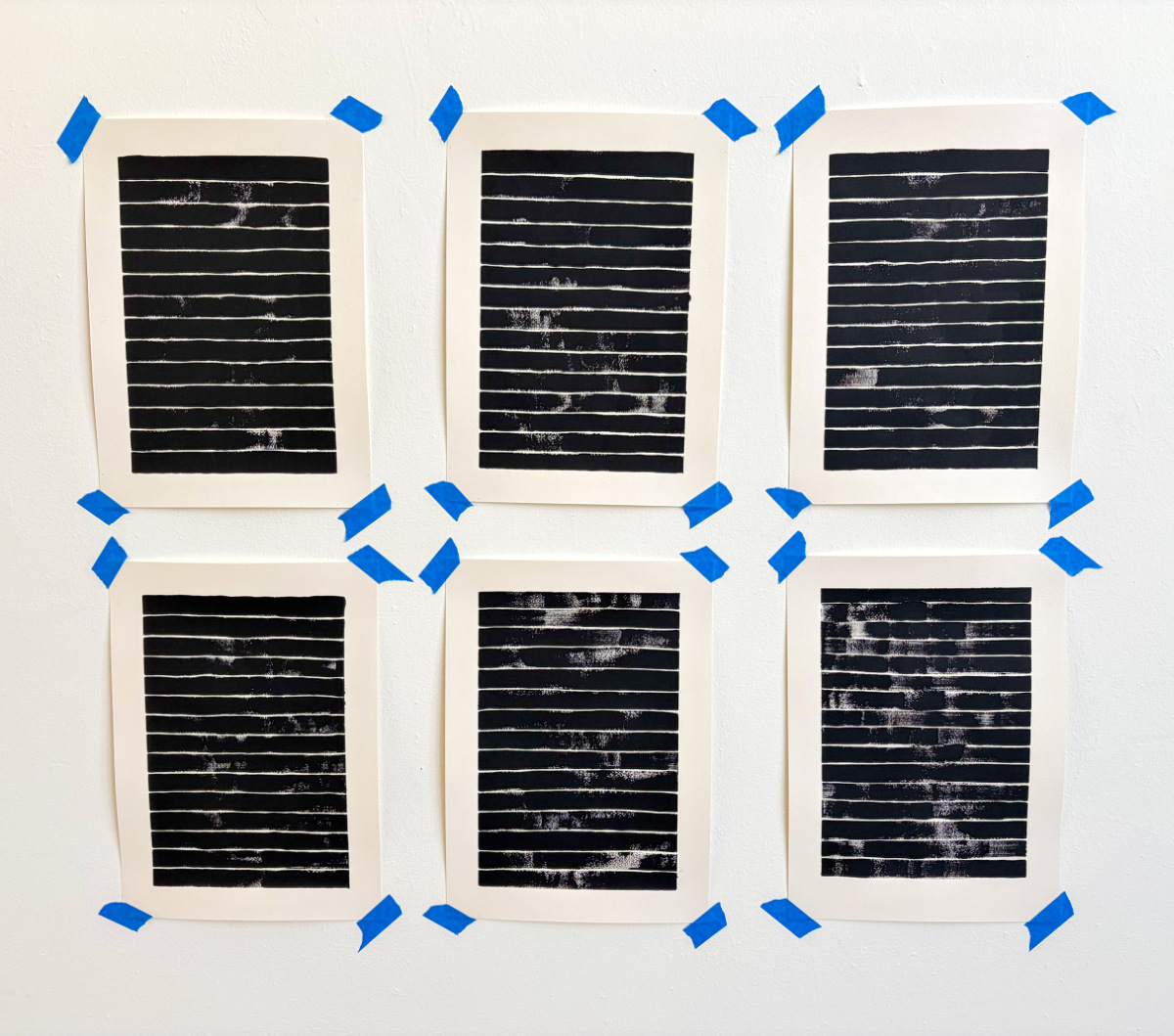
Those that didn’t make it
Those that didn’t make it
I want to talk a little bit about failure.
This is a photo of the wall next to my desk where I’m currently working on the 2026 edition of my ongoing series, Standing Still In A Storm. I’ve been doing this project for close to 15 years now, with each year the guidelines changing a little bit. The basics remain the same: painted freehand parallel lines in black gesso that are not allowed to touch but meant to get as close as possible to one another. The paper size, border measurements, and brush width vary year-to-year, but the general rules are always the same.
So far, this year I’ve finished 18 pieces—including these six failures. For one reason or another, each of these did not meet the standards I have for the work. On some the ink bled under the tape (an issue I did not discover until the work was already complete and otherwise satisfactory). On some the slightest twitch of my hand caused the black lines to meet at some point. On others the proportions weren’t right and by the time I got to the last line it ended up wider than the brush I’m using. Whatever the reason, these are the failures—one-third of the work I’ve done so far.
I feel like artists online only ever show their successes. The ones who post process videos only do so when the final work is suitable for publishing. Content creators and influencers crop frames and set up shots that don’t actually represent what they’re doing. The rule of advertising is that everything has to be positive all of the time, and the internet has become one big advertisement for life. It’s all success stories, and I wonder how many of them are outright lies.
The thing is, everybody fails. The process of taking inspiration to creation is an arduous one. Yet in a society that demands better results faster, standards lessen, quality drops, concepts fade, and the finished product is cheapened. It’s no wonder those obsessed with capital love AI—it removes all the parts that take time from creativity, but in doing so it also removes everything that makes a creation good.
Failure is important to process. It’s a learning experience, much more so than achievement. By having this entire sect of culture that only shows finished products, it becomes akin to something between a gallery and a mall. The human values have been lost, and it’s not because people don’t fail, but because in the public eye, they’re not allowed to.
(Like everyone else, I review the films I see on Letterboxd, but I write about movies as a general idea here.)
Zach Cregger has made a Resident Evil movie and it looks awesome. I’m a big fan of both Barbarian and Weapons and have always enjoyed the games when I’ve played them, so I’m pretty stoked on this. Will it win Best Picture? No. Will it be fun as hell? Probably.
Here’s the kicker, though: I love Resident Evil. I don’t mean the IP or any of the specific games. I mean the original movie from 2002 starring Milla Jovovich. I enjoy all of its 100-minute runtime. I can totally admit it’s 100% a bad movie. It’s a bad script with terrible acting and some really awful special effects. Yet still, I love it. It’s a guilty pleasure.
There’s been online discourse of late saying there’s ‘no such thing‘ as a guilty pleasure, or we need to take away the shame of it. (NPR even took a look at the brain science behind the concept.) I would argue the middle ground is where we should land as a society—yes, there are guilty pleasures, but we should also not fear any kind of public shame for indulging in them.
I think a person should be proud to admit they have a guilty pleasure in art or culture because at least they’re admitting to understanding the idea that there are echelons of these things produced in terms of meaning and substance. If you say a Marvel movie is a guilty pleasure, you’re admitting you understand that it’s corporate franchise slop written at a fifth-grade level designed for nothing more than a dopamine rush, but you just don’t care. And that’s fine. It’s the understanding that matters.
I’m not always watching arthouse films. Hell, Bad Boys II is a piece of capitalist copganda and I love the shit out of it. But I know that Michael Bay wasn’t setting out to ask societal questions when he had Will Smith dodging boats in a Ferrari while speeding across a Miami bridge. He just wanted to throw boats at a car on a freeway.
However, I can say that movie, or Resident Evil, is a guilty pleasure because I know there are arthouse movies out there that Ask Serious Questions About Life, that exist because a filmmaker wanted to make us leave a theater with a new thought or idea about the world around us. I know that, while entertainment can be fun and relaxing, art and the concepts that creatives process during crafting a film or writing a novel is where we actually discover things about our humanity. Any moral quandary posed by a Marvel movie has been vetted by the CIA, while a David Lynch film will leave a person wondering what morality originates from.
I have a friend here who is a very good, serious artist. I was at her place once staring at this massive painting of a tree she had splayed out across the floor of her entire apartment. In the corner, her television showed one of her streaming accounts and all of the ‘Recently Played’ section was filled with episodes of one reality show or another. I asked about it and she proudly said she loved it all—she could work with them on in the background, not having to worry about her attention being distracted by something heavy or some plot point she had to pay attention to. Also, they were just entertaining. It made sense.
She and I both know plenty about Serious Art, but also that there’s plenty of reasonable occasions to indulge in whatever bullshit might exist for the sole purpose of vapid entertainment. I tend to think the issue of American culture is that we’re increasingly being pushed in the direction of that void of uncaring, incompetent slop. Stephen Spielberg and John Williams teamed up to create one of the most iconic films ever made in Jurassic Park, which is now just a recurring CGI-fest of absurdity and nonsensical plot lines. Our entertainment is getting dumber, and our society is culturally worse for it.
I think the danger of a guilty pleasure lies in not knowing that it is one, or why it is one. To not understand that the new Avengers movie and Zodiac might both star Robert Downey Jr but the latter is a significantly different type of film is a kind of cultural illiteracy that I think we’ve generally waded into as a society, and instead of trying to right that wrong, we’re trying to take away any stigma about the shame of preference—even though that preference is nothing to be guilty about, but understanding the holistic nature of why culture matters to humanity is an inherently important and valuable part of life experience.
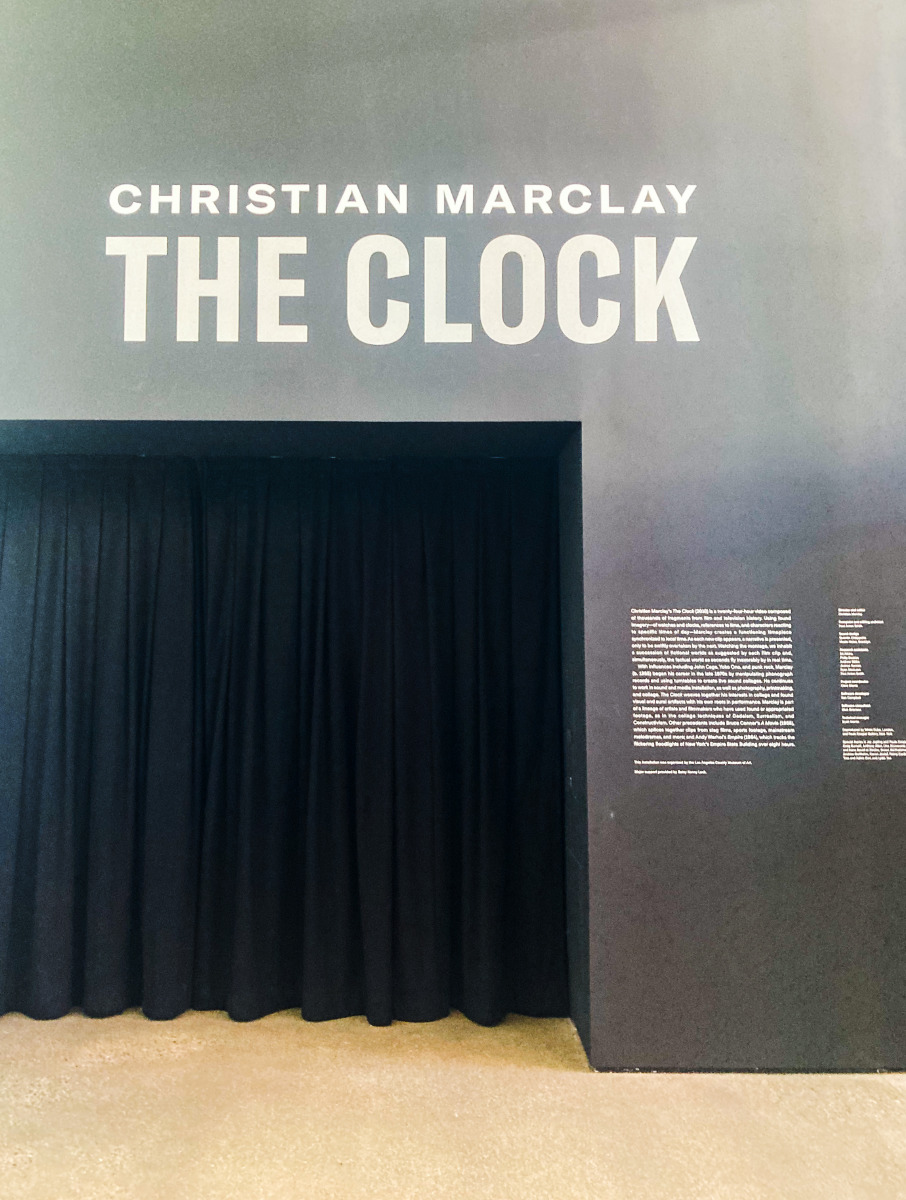
Entering The Clock at LACMA
I spent 13 hours of my life last week with The Clock, an absolutely monumental piece of video art that caught me completely off guard by, after watching 20 seconds, had me fully committed to watching as much of the 24-hour runtime as possible.
The premise of the work is fairly straightforward: it’s a 24-hour piece that takes place in real time. It splices together scenes from the entire history of media—mostly American but there’s occasional Asian and European content as well—that display or discuss the time and puts them on screen at that time. So, if you check your watch at 7:24 PM, on-screen there will be a scene from a television show or movie where a clock displays the time 7:24 or a character asks what time it is and someone replies, “It’s 7:24.” The splices are quick, so every minute on screen might get five or ten references (popular times in entertainment, such as the stroke of midnight, can get upwards of 20).
On top of simply displaying the time, though, the film is edited with underlying themes and semi-narratives. Doors and telephones play a dominant role in the imagery used. Characters eat during meal hours, go to work in the morning, make themselves a drink around five, go on dates at night. The generic standard for ‘a day in the life’ of a contemporary person is illustrated throughout the entire work.
It’s fascinating and immersive and, above all, left me in a constant state of wonder. How the hell did Marclay pull this off?
This isn’t the first time this year I’ve been left in wonder of the process of a film. One of my favorite releases of 2026 has been Nirvana The Band The Show The Movie, which, on top of being laugh-out-loud hilarious, had me constantly asking myself the same question: How did they make this movie?
Though these examples happen to both be films, works like The Clock are great pieces of evidence as to why art made by humans is important and can never be replaced by AI. Replicated, possibly, but never replaced. I am sure that, if not now, then in the near future, someone could prompt a computer to look through the history of media and select scenes that display the time and assemble a film from it. Watching that would end up being such a different experience, because there’s no quality of passion to it. Nobody sat through hours of footage and carefully assembled mini-stories that conveyed human emotion. It would not be a spectacle of achievement that would make you proud to be human. Prompting a computer to do your work for you is not, and never will be, art.
Yesterday I went to a 24-hour screening of The Clock and left at 12:15 AM, after watching six hours of the film. I was spent. I left a completely packed theater to see a line outside of over 100 waiting to get in still. That’s the power of art when someone pours themselves into a process of creation. No computer generated prompt is going to get this kind of response because nobody with a soul will be able to relate to it. There will never be a reason to care about what AI can ‘make.’
Seeing this piece left me with so many thoughts and feelings, but one that left a large impression was understanding that the AI companies and people behind them can steal all they want from the history of art, but not a single thing any of them ever make or do with it will hold a candle to an original drawing made by a pencil and a piece of paper, much less a massive accomplishment like this.
I’ve been to a few art openings recently and I’ve noticed this trend of oversized, low-resolution digital works that were basically just slapped together in Photoshop, printed and hung on name-brand gallery walls. They were aesthetically awful, but came with a multi-page artist statement full of buzz words.
There’s a problem in contemporary art where artist statements become the main focus of a work. Intention and the ability to communicate in a language style that represents intellectualized considerations seems to matter more than how a work actually looks. I’m not trying to advocate for style over substance, but this growing pattern where what someone writes about art against what they actually produce feels like it’s buying in to the capitalist ideology of a class-based society.
I was at a group show last week that was selling the booklet of artist statements for $15, which I thought was crazy. I like conceptual art and there’s certainly plenty of great work in the world produced from it, but I also think that using the concept as a basis for actually showing work is prioritizing the wrong side of the coin.
Yes, everyone has different tastes and there should be an opportunity for every idea to be on display, but it feels increasingly like there’s this undercurrent of MFA-types who are getting away with spending more time indulging in navel gazing than working through the trials of process that end up producing aesthetically pleasing work. (If something being aesthetically repulsive is part of the concept, then that’s fine, but if you simply won’t spend the time to try and make something and just paste bullshit together, that seems cheap.)
It just feels like some artists try to convey they went to an MFA program through how they talk about their work, which buys into the idea you need to go through the institution of higher education to become a gallery artist. It’s very reflective of how a caste system works and I think that should have nothing to do with art. Writing about a piece of art is a fine addendum, but the work should be able to speak for itself.
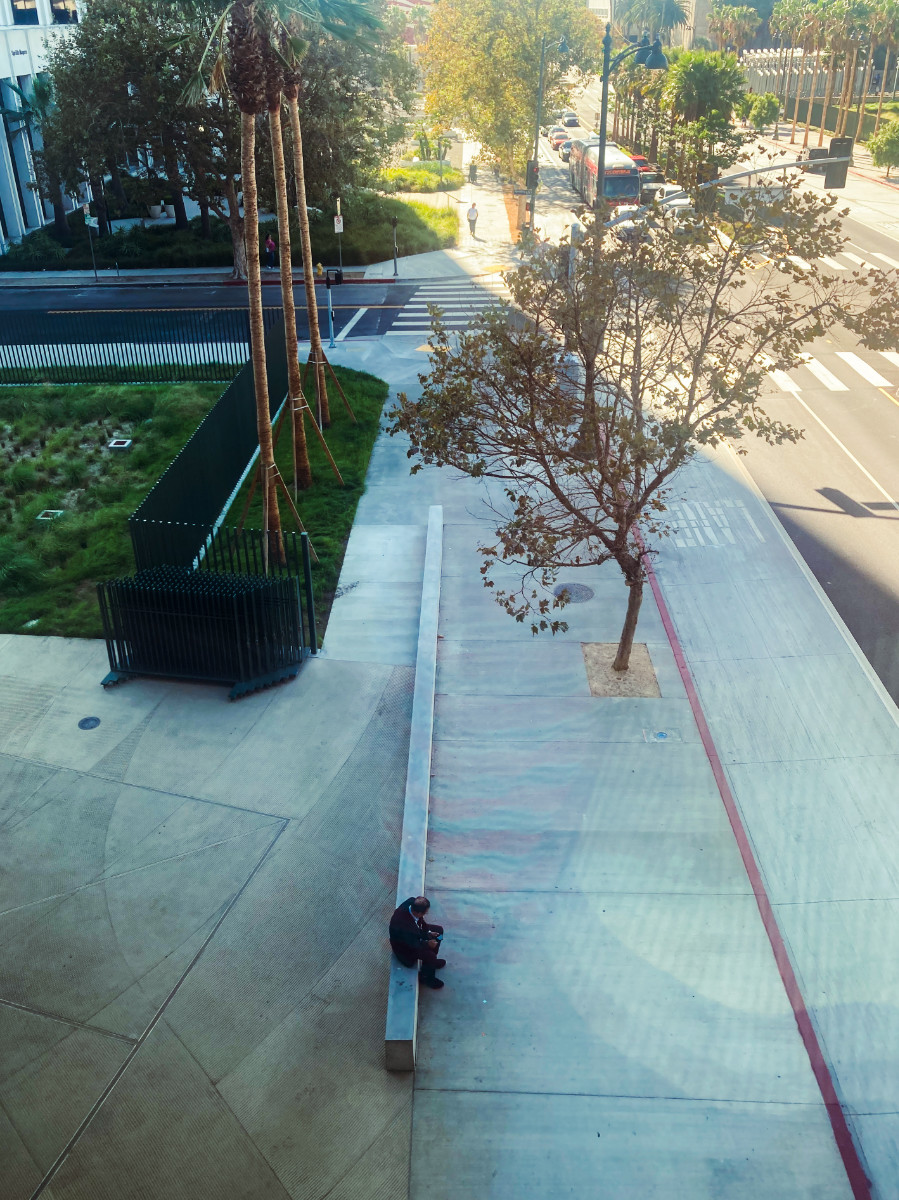
What living in LA is actually like most of the time
Today at LACMA I stood next to Jeff Goldblum in front of a giant Matisse for a few minutes. I didn’t want to bother him (plus he had a couple people with him that looked like they were there to protect him from public nuisance), but it is sort of just a thing that happens here and is always funny when it does.