guilty pleasures

(Like everyone else, I review the films I see on Letterboxd, but I write about movies as a general idea here.)

Zach Cregger has made a Resident Evil movie and it looks awesome. I’m a big fan of both Barbarian and Weapons and have always enjoyed the games when I’ve played them, so I’m pretty stoked on this. Will it win Best Picture? No. Will it be fun as hell? Probably.

Here’s the kicker, though: I love Resident Evil. I don’t mean the IP or any of the specific games. I mean the original movie from 2002 starring Milla Jovovich. I enjoy all of its 100-minute runtime. I can totally admit it’s 100% a bad movie. It’s a bad script with terrible acting and some really awful special effects. Yet still, I love it. It’s a guilty pleasure.

There’s been online discourse of late saying there’s ‘no such thing‘ as a guilty pleasure, or we need to take away the shame of it. (NPR even took a look at the brain science behind the concept.) I would argue the middle ground is where we should land as a society—yes, there are guilty pleasures, but we should also not fear any kind of public shame for indulging in them.

The innocence of guilt

I think a person should be proud to admit they have a guilty pleasure in art or culture because at least they’re admitting to understanding the idea that there are echelons of these things produced in terms of meaning and substance. If you say a Marvel movie is a guilty pleasure, you’re admitting you understand that it’s corporate franchise slop written at a fifth-grade level designed for nothing more than a dopamine rush, but you just don’t care. And that’s fine. It’s the understanding that matters.

I’m not always watching arthouse films. Hell, Bad Boys II is a piece of capitalist copganda and I love the shit out of it. But I know that Michael Bay wasn’t setting out to ask societal questions when he had Will Smith dodging boats in a Ferrari while speeding across a Miami bridge. He just wanted to throw boats at a car on a freeway.

However, I can say that movie, or Resident Evil, is a guilty pleasure because I know there are arthouse movies out there that Ask Serious Questions About Life, that exist because a filmmaker wanted to make us leave a theater with a new thought or idea about the world around us. I know that, while entertainment can be fun and relaxing, art and the concepts that creatives process during crafting a film or writing a novel is where we actually discover things about our humanity. Any moral quandary posed by a Marvel movie has been vetted by the CIA, while a David Lynch film will leave a person wondering what morality originates from.

Go for it

I have a friend here who is a very good, serious artist. I was at her place once staring at this massive painting of a tree she had splayed out across the floor of her entire apartment. In the corner, her television showed one of her streaming accounts and all of the ‘Recently Played’ section was filled with episodes of one reality show or another. I asked about it and she proudly said she loved it all—she could work with them on in the background, not having to worry about her attention being distracted by something heavy or some plot point she had to pay attention to. Also, they were just entertaining. It made sense.

She and I both know plenty about Serious Art, but also that there’s plenty of reasonable occasions to indulge in whatever bullshit might exist for the sole purpose of vapid entertainment. I tend to think the issue of American culture is that we’re increasingly being pushed in the direction of that void of uncaring, incompetent slop. Stephen Spielberg and John Williams teamed up to create one of the most iconic films ever made in Jurassic Park, which is now just a recurring CGI-fest of absurdity and nonsensical plot lines. Our entertainment is getting dumber, and our society is culturally worse for it.

I think the danger of a guilty pleasure lies in not knowing that it is one, or why it is one. To not understand that the new Avengers movie and Zodiac might both star Robert Downey Jr but the latter is a significantly different type of film is a kind of cultural illiteracy that I think we’ve generally waded into as a society, and instead of trying to right that wrong, we’re trying to take away any stigma about the shame of preference—even though that preference is nothing to be guilty about, but understanding the holistic nature of why culture matters to humanity is an inherently important and valuable part of life experience.

on the clock and human achievement

The Clock

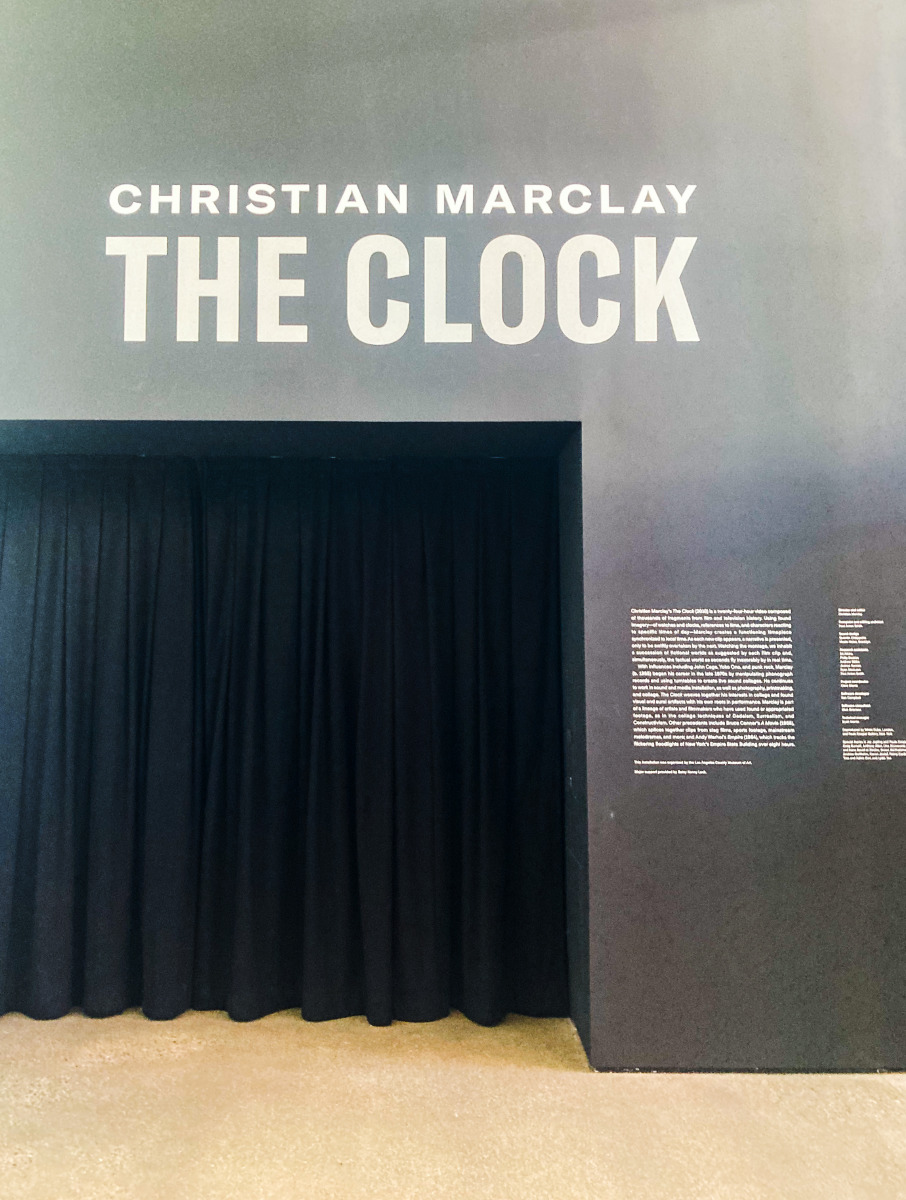
Entering The Clock at LACMA

I spent 13 hours of my life last week with The Clock, an absolutely monumental piece of video art that caught me completely off guard by, after watching 20 seconds, had me fully committed to watching as much of the 24-hour runtime as possible.

The premise of the work is fairly straightforward: it’s a 24-hour piece that takes place in real time. It splices together scenes from the entire history of media—mostly American but there’s occasional Asian and European content as well—that display or discuss the time and puts them on screen at that time. So, if you check your watch at 7:24 PM, on-screen there will be a scene from a television show or movie where a clock displays the time 7:24 or a character asks what time it is and someone replies, “It’s 7:24.” The splices are quick, so every minute on screen might get five or ten references (popular times in entertainment, such as the stroke of midnight, can get upwards of 20).

On top of simply displaying the time, though, the film is edited with underlying themes and semi-narratives. Doors and telephones play a dominant role in the imagery used. Characters eat during meal hours, go to work in the morning, make themselves a drink around five, go on dates at night. The generic standard for ‘a day in the life’ of a contemporary person is illustrated throughout the entire work.

It’s fascinating and immersive and, above all, left me in a constant state of wonder. How the hell did Marclay pull this off?

The Power of the Process

This isn’t the first time this year I’ve been left in wonder of the process of a film. One of my favorite releases of 2026 has been Nirvana The Band The Show The Movie, which, on top of being laugh-out-loud hilarious, had me constantly asking myself the same question: How did they make this movie?

Though these examples happen to both be films, works like The Clock are great pieces of evidence as to why art made by humans is important and can never be replaced by AI. Replicated, possibly, but never replaced. I am sure that, if not now, then in the near future, someone could prompt a computer to look through the history of media and select scenes that display the time and assemble a film from it. Watching that would end up being such a different experience, because there’s no quality of passion to it. Nobody sat through hours of footage and carefully assembled mini-stories that conveyed human emotion. It would not be a spectacle of achievement that would make you proud to be human. Prompting a computer to do your work for you is not, and never will be, art.

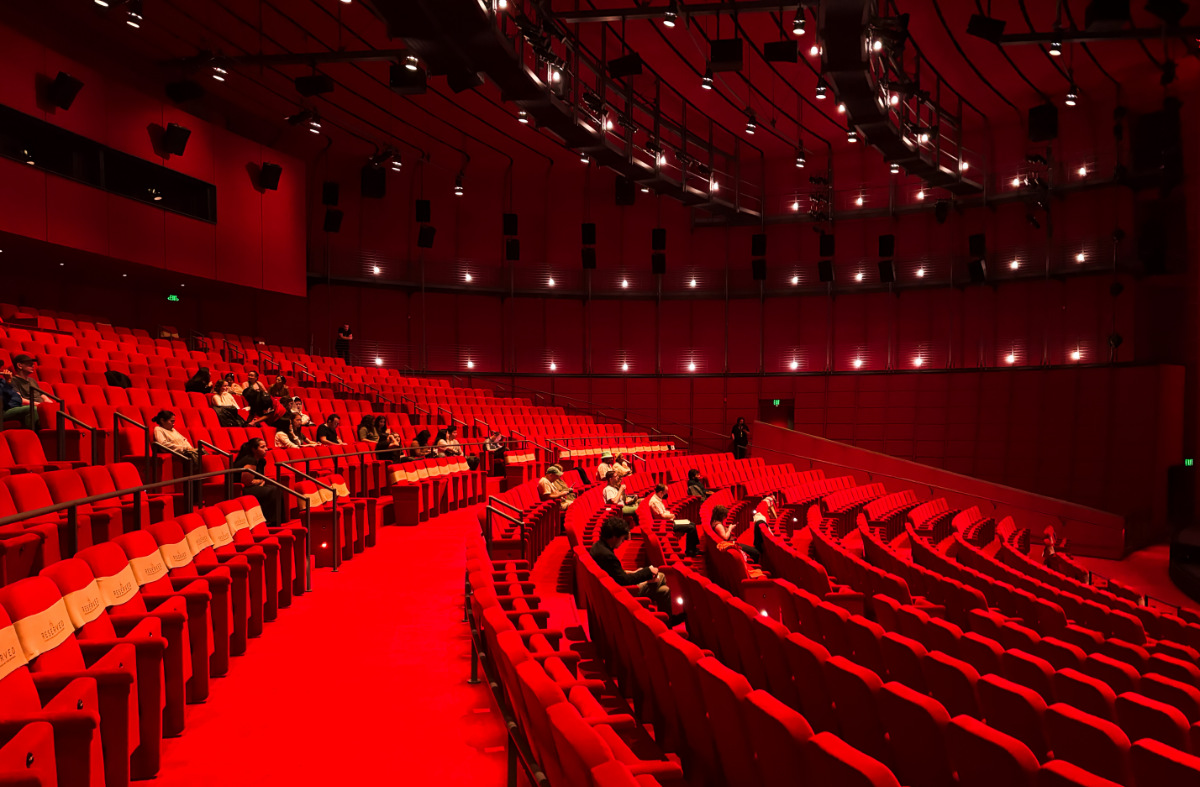
Yesterday I went to a 24-hour screening of The Clock and left at 12:15 AM, after watching six hours of the film. I was spent. I left a completely packed theater to see a line outside of over 100 waiting to get in still. That’s the power of art when someone pours themselves into a process of creation. No computer generated prompt is going to get this kind of response because nobody with a soul will be able to relate to it. There will never be a reason to care about what AI can ‘make.’

Seeing this piece left me with so many thoughts and feelings, but one that left a large impression was understanding that the AI companies and people behind them can steal all they want from the history of art, but not a single thing any of them ever make or do with it will hold a candle to an original drawing made by a pencil and a piece of paper, much less a massive accomplishment like this.

and the oscar goes to…

Of all the creative professions, acting is the one I have the hardest time reconciling an appreciation for. It’s not directly the fault of actors, but the culture of celebrity that has grown out of Hollywood and infected so much of how the United States operates—I mean, so much in this country is factored around fame and notoriety. While it’s not the fault of any one actor, the entire cultural phenomenon of the ‘movie star’ and its impact on the rest of us is grotesque and makes me feel the people who actually vie for that title are akin to those running for Prom King and Queen of the arts.

That being said, every now and then an actor comes along who is just so good that any fame they pick up along the way only seems fitting. Actors like Phillip Seymour Hoffman (RIP), Meryl Streep, and Daniel Day-Lewis are among names where it’s like, sure, they’re famous, but their fame is a byproduct of their talent. With the new trailer for Primetime coming out today, it’s pretty obvious that now Robert Pattinson is coming up to place his name among that list.

The irony being, of course, that this guy got his start as part of a giant teenybopper IP vampire franchise—but has since done outstanding character studies across a slate of independent stalwarts (a doomed brother in Good Time, a philosophical capitalist in Cosmopolis, an insane drunk in The Lighthouse, a dreamer in Maps To The Stars, a lost husband in Die My Love) as well as taking on giant blockbusters in ways that aren’t necessarily straightforward leading-man approaches (a reserved Bruce Wayne in The Batman, a fine-with-playing-second-fiddle operative in Tenet, the weird cloned double-lead of Mickey 17).

Then you have the four films he’s doing this year—leading roles in Primetime and The Drama and supporting roles in The Odyssey and Dune Part Three. Four wildly different roles in four films that are all going to make one year-end of list or another.

To me, there’s the impressive talent for sure, but another thing to look at is how an artist chooses their path. A guy that looks the way Pattinson does could have taken the Ryan Reynolds route and starred in the same generic romantic comedy year after year, stacking up paychecks and interviews with Seventeen magazine. Instead, he opted for challenging and particular roles generally backed by interesting writing and good collaborators—all the tell-tale signs of what makes acting and working in film or theater fun to begin with.

In an age where too many big names are cashing in on multi-film Marvel contracts, it’s good to see movie stars exist for people who actually love the movies. It’s important to see artists who have achieved success continue to push themselves deeper into craft, and hopefully that will inspire the next generation to not just adopt the idea that IP or AI green-screen slop cash-outs are the best way forward.

entertaining the idea of art

Man, Emily Wilson sure took Chris Nolan and The Odyssey to task in her review and I am all for it. If you’ve seen the film, the entire piece is worth reading—but the conclusion really brings her point home:

Nolan’s Odyssey lacks many of the elements that make the poem great. It has nothing convincing to say about time, memory, history, war, or about the relationship between one warrior’s glorious return and the lives of his family, adversaries, comrades, friends and neighbours. It lacks psychological, emotional, political and ethical depth. Its narrative structure is gimmicky. The writing is abysmal. None of the characters has convincing motivation for their actions or words. There are no sex scenes, and all the food looks horrible.

The most troubling ethical problem with Nolan’s Odyssey concerns the decision to film part of the movie in the occupied territory of Western Sahara, thus normalising the ongoing violence against the indigenous Sahrawi people. It is particularly galling that Nolan used this land simply as a visually striking backdrop for a film that centres, aggrandises and redeems the hero of a territorial war on account of his belated and partial acknowledgment of his own guilt.

For far too long, Chris Nolan has been relatively immune to criticism for reasons unknown. Perhaps it’s the striking imagery he’s been able to create—the black hole in Interstellar, the folding cities of Inception, the bomb in Oppenheimer—or maybe it’s that a couple performances have been Oscar-worthy (I would say Heath Ledger in The Dark Knight is the only truly great performance in a film of his, though). Whatever the reasoning, he’s considered critically by many journalists and social media cinephiles alike as one of the premier directors of this generation and I am absolutely dumbfounded as to why (I find Interstellar and Oppenheimer both to be as overrated as The Odyssey).

Good writing is the foundation of any cinematic achievement and none of Nolan’s films have had an above-average script. Worse still is his direction of conversational dialogue, which is often choppy on top of being drowned out by sound design that favors background environments and nonstop scores. His female characters are often hollow and disposable (and even the men are largely one-dimensional). He excels in aesthetic scale but consistently fails to deliver on any emotional, human level. It raises the questions: What are modern audiences looking for in a film, anyway? Why are these movies considered among the best of our time?

I can’t help but think this is less about Nolan being a bad director than it is more a sign of what art means to a society so molded by the vacuous, profit-driven ambitions of capitalism. Humanity must be stripped from most endeavors or people might feel guilty about the collateral damage that ensues from endlessly prioritizing financial well-being over that of the communities this economic model ‘serves.’ Under this ideological weight, art is chipped away at until it becomes nothing more than shallow entertainment—unchallenging to the audience or the interests behind the scenes that fund it. Consequently, we get these grand films of empty rhetoric which, more than anything else, become statements on the decline of our appreciation for the potential of culture in America.