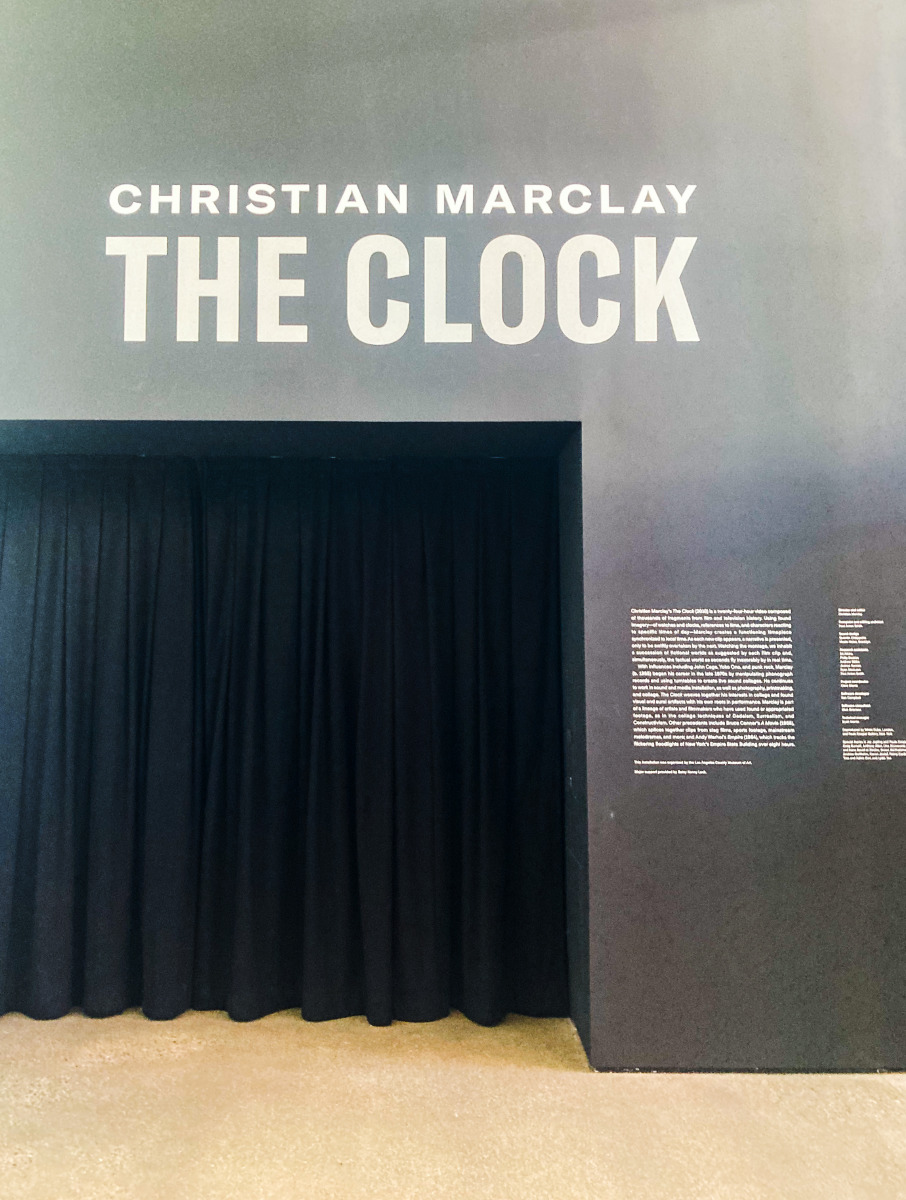
Entering The Clock at LACMA
Entering The Clock at LACMA
I spent 13 hours of my life last week with The Clock, an absolutely monumental piece of video art that caught me completely off guard by, after watching 20 seconds, had me fully committed to watching as much of the 24-hour runtime as possible.
The premise of the work is fairly straightforward: it’s a 24-hour piece that takes place in real time. It splices together scenes from the entire history of media—mostly American but there’s occasional Asian and European content as well—that display or discuss the time and puts them on screen at that time. So, if you check your watch at 7:24 PM, on-screen there will be a scene from a television show or movie where a clock displays the time 7:24 or a character asks what time it is and someone replies, “It’s 7:24.” The splices are quick, so every minute on screen might get five or ten references (popular times in entertainment, such as the stroke of midnight, can get upwards of 20).
On top of simply displaying the time, though, the film is edited with underlying themes and semi-narratives. Doors and telephones play a dominant role in the imagery used. Characters eat during meal hours, go to work in the morning, make themselves a drink around five, go on dates at night. The generic standard for ‘a day in the life’ of a contemporary person is illustrated throughout the entire work.
It’s fascinating and immersive and, above all, left me in a constant state of wonder. How the hell did Marclay pull this off?
This isn’t the first time this year I’ve been left in wonder of the process of a film. One of my favorite releases of 2026 has been Nirvana The Band The Show The Movie, which, on top of being laugh-out-loud hilarious, had me constantly asking myself the same question: How did they make this movie?
Though these examples happen to both be films, works like The Clock are great pieces of evidence as to why art made by humans is important and can never be replaced by AI. Replicated, possibly, but never replaced. I am sure that, if not now, then in the near future, someone could prompt a computer to look through the history of media and select scenes that display the time and assemble a film from it. Watching that would end up being such a different experience, because there’s no quality of passion to it. Nobody sat through hours of footage and carefully assembled mini-stories that conveyed human emotion. It would not be a spectacle of achievement that would make you proud to be human. Prompting a computer to do your work for you is not, and never will be, art.
Yesterday I went to a 24-hour screening of The Clock and left at 12:15 AM, after watching six hours of the film. I was spent. I left a completely packed theater to see a line outside of over 100 waiting to get in still. That’s the power of art when someone pours themselves into a process of creation. No computer generated prompt is going to get this kind of response because nobody with a soul will be able to relate to it. There will never be a reason to care about what AI can ‘make.’
Seeing this piece left me with so many thoughts and feelings, but one that left a large impression was understanding that the AI companies and people behind them can steal all they want from the history of art, but not a single thing any of them ever make or do with it will hold a candle to an original drawing made by a pencil and a piece of paper, much less a massive accomplishment like this.