
Reflecting
Reflecting
There’s this really famous scene from the first season of The West Wing where, after an episode of built-up debate surrounding funding for public education, Rob Lowe makes this speech about how, “Education is the silver bullet.” It’s been on my mind today.
This liberal-minded idea that if we were all just smarter everything would be magically fixed about society is pretty insane. Every election it’s a manufactured debate—how did the college-educated vote against the non-college-educated? It becomes a whole discourse, another thing that keeps us divided.
But those Cornell rapists? Well, they’re going to Cornell. Aren’t they educated? George W Bush, Dick Cheney, the Clintons, and JD Vance all went to Yale. Benjamin Netanyahu graduated from MIT while taking classes at Harvard. Richard Nixon went to Duke. I’m pretty sure it’s a requirement to go to Oxford to be Prime Minister in England. Half of the psychopath tech guys in Silicon Valley attended Stanford.
I do believe that all education should be free and excellent, but these ideas that cross into areas of discrimination and bias about intellect and aptitude and leadership can really irk me. The people who have done the most harm to the world are the ones who come from the best schools. An education happens in many ways outside of reading pages from a book and it doesn’t take much time to see in the news what these men are really learning in American schools.
It’s hard to write about the fraternity rape at Cornell. Not because the story is surprising by any stretch of the imagination, but because it isn’t.
Hope has felt like a lost cause lately. Even if the seven directly accused in this case all went to prison, it wouldn’t change frat culture nationwide (where I would imagine stories like this happen far more frequently than anyone wants to think about). This incident is a symptom, not the disease. And this disease in particular is just like, a variant of a larger, deadlier one rotting away at everything in this godforsaken country.
These days I’ve been thinking a lot about Confederate flags. There was this whole segment of the United States that had to be literally beaten into submission and practically burned completely to the ground due to an unflinching support of a great evil. And still today, people fly that flag with pride, hoping for a systemic resurrection.
All I know is that everything is cyclical. We are in a moment of opinion, and at some point, someone is going to say, “Talk is cheap,” and the first domino in what happens next will fall. Violent institutions and the systems that protect them inevitably create a violent response, and every day we’re getting new examples as to why it’s time to burn it down, flags and all.
Though most of my thoughts on my recent hospital stay are in the previous post, I had once incident that was very bizarre and completely outside of the healthcare system: I posted a single selfie to Instagram—a photo of me lying in my bed once I was admitted—and it received more views than anything I’d posted in years. People who never, ever view my stories saw it. The total view count was triple what I average for a story. It made no sense, so naturally I was thinking of why this was happening.
The most logical conclusion I could come to was that the algorithm took notice of my environment and prioritized the story in people’s individual feeds, so those who were just scrolling through ‘new’ but followed hundreds or thousands of accounts would see it. (Even this feels a little inaccurate, as I’m pretty sure I had views from people who don’t follow me anymore, but at one point did.) If this were to be the case, it provokes a few interesting questions.
One is from their vantage point: why was my account suddenly promoted on their feeds? Was it to provoke concern? I’ve posted other pictures of myself before that don’t get nearly the interaction. What about being in a hospital, specifically, created this kind of boost, and why?
The second is for my side of the coin: what is this supposed to communicate to me? If I was, say, a teenager who was living for view counts (possibly one of the addicted teens who Meta just had to pay out $17 billion for exploiting), this would tell me the more I ended up in the hospital, the more people would see my story. That doesn’t sound like a recipe for anything good, especially if I’m 15 and prioritize my social network above myself.
Whatever the truth may be, due to the despicable nature of Meta and the complete disregard for the mental well-being of its users, something about this feels outright evil. There’s no way to really prove any nefarious intent, but for the 24 hours my story was online, it certainly felt like something was amiss.
I had to spend a couple days in the hospital. It is what it is, I feel like the people around me were way more stressed out about it than I was. For whatever reason, this sort of thing just doesn’t phase me. (I have heard that alcoholics specifically are exceedingly good in high-stress situations, which is part of the reason they’re so insane when life is just kind of boring.) But anyway.
A few observations I had during my stay in Pasadena about the experience and/or the state of the US healthcare system:
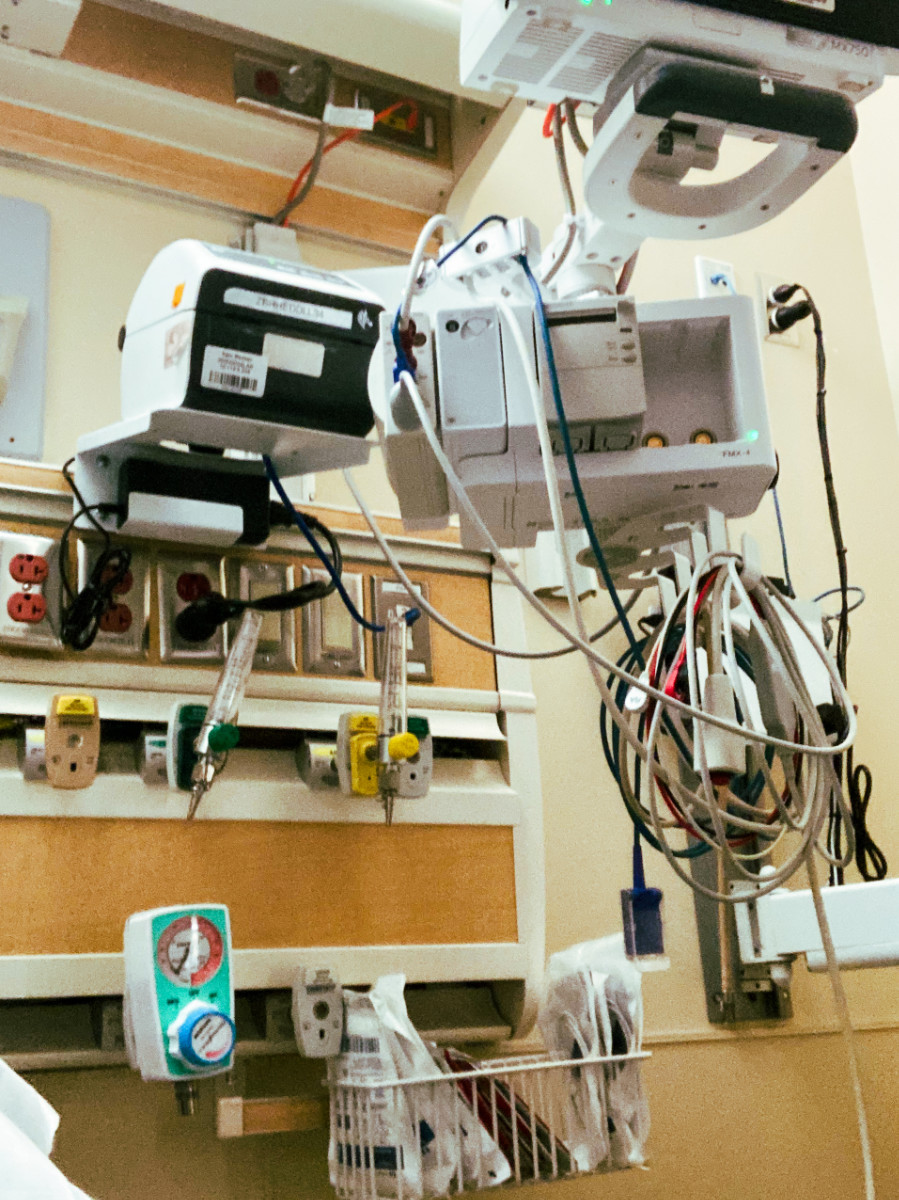
My view for a couple days
One: Repeating yourself becomes craze-inducing.
I had to answer the same set of questions about 17 or 18 times. Most of them were covered by my initial referral from my primary care physician. I couldn’t tell if doctors just never talk to one another (more on that later) or if the notes they take are just so brief that, even if the next one down the line reads it, so many details get left out that they have to ask again. Nobody seems on the same page and it creates a real sense of doubt.
Two: The profiteering is grotesque.
I take two daily psych meds and brought them both with me. Upon being admitted, the hospital confiscated these and said they will bring me their meds from their pharmacy each day I needed them. Of course, when they were brought up to me, the little individual packets were scanned into their system for an inevitable charge. (My 200mg dose pill was also broken up into two, 100mg doses for that extra charge.) On top of healthcare already being overpriced, this felt like outright theft.
Three: Conclusions are not really that conclusive.
After two-and-one-half days of procedures, tests, questions, and lying around waiting for the next set of procedures, tests, or questions, I had about four wrap-up visits with relatively high-up specialists or department heads. Each one gave me a generally different answer as to what their belief was as to why I ended up at the hospital to begin with. (To be fair, the initial issue was kind of wild.) But, like having to constantly repeat myself answering questions to begin with, leaving without actually having any confidence as to what was—and possibly still could be—wrong feels pretty disorienting.
Honestly, I had what was overall a good experience. My initial wait in the ER was just a few hours (granted I went at 10:00 pm). The hurry-up-and-wait parts of my visit were not out of hand. Everyone was nice. And still the only thought I had at the end was, Don’t get sick in America. The healthcare situation is so dismal here, I cannot understand why people defend it against the idea of a universal, public system.