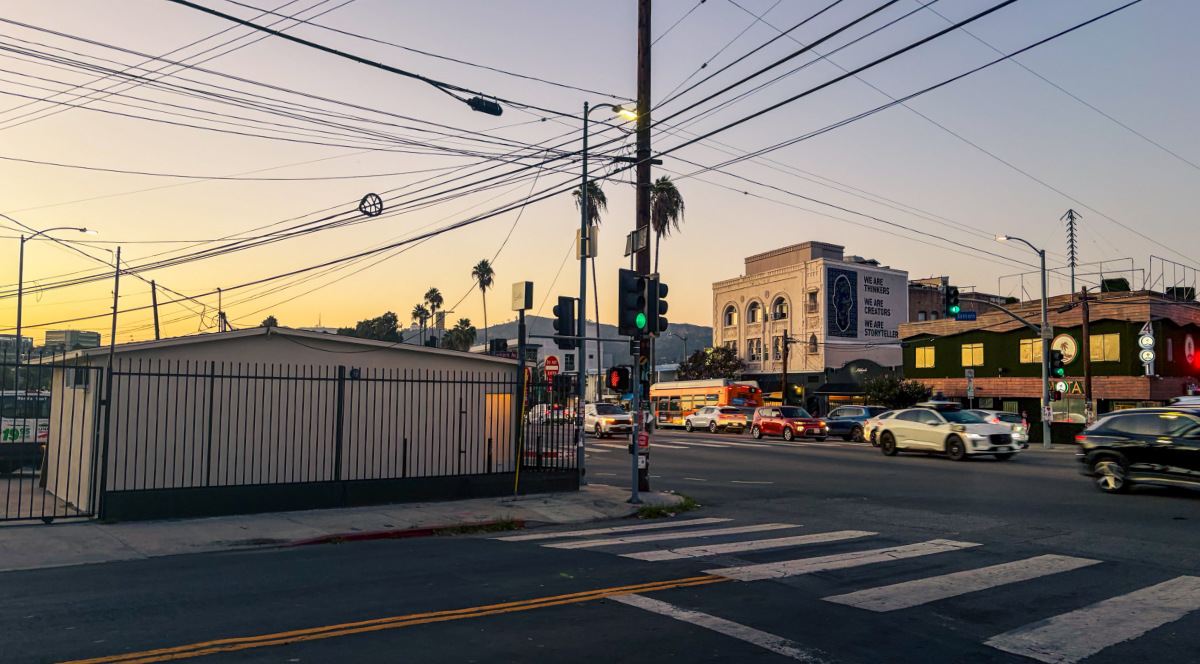
Sunset Junction in Silver Lake
Sunset Junction in Silver Lake
One of the maddening parts of LA culture is that some restaurants are hot spots to be seen in, and so they probably get more business than the food actually deserves. When you don’t know this before making a reservation, you end up overpaying for a mid meal just because the place is on a trendy block off Sunset. Whoops.
(Then there’s always the later part of the night where driving becomes a competitive sport while street signs and traffic lights are largely disregarded and double parking and careless pedestrians crowd every other street. Sometimes I think the 2028 Olympics should feature a special LA-based contest called Taking Your Life In Your Hand By Driving Down The 110 From Highland Park To The 10 West After Dark.)
Watching Ed Sheeran’s career implode this week has been a delight. He dropped Macklemore from his tour due to pressure from known associate of Jeffery Epstein Robert Kraft regarding voicing support for Palestine on stage. The fallout from Sheeran’s spineless bending of the knee to billionaire Zionists has been wonderful. Everyone else performing (including his backing band) left the tour while Macklemore pledged $1 million of his earnings from the tour to Palestine Aid.
It’s unfortunate but the only way to really change things under capitalism is to fuck with Big Money. Though some some celebrity entertainers who remain ‘apolitical’ (Taylor Swift and Jay-Z come to mind) for the sake of their ticket sales are still kind of untouchable from public criticism, this fall-off for Sheeran suggests the protests against Israel have reached a new level in American discourse. The general public cares more about celebrities than most things, and this kind of attention will hopefully provoke those at the top to understand standing with Israel—or deciding to not comment on the matter and thus side with the genocide—could potentially lead to major losses in both income and legacy.
With the Trump administration agreeing to sell $2.8 billion in arms to Israel, Sheeran’s disaster is helping to increase the scope of debate about the United States’ position in funding genocide and protecting an apartheid state—and what it means to say, No Comment.
At this point I will not even speak to someone who supports Israel (except maybe to tell them to get fucked). There is no excuse for ‘not picking a side’ regarding (much less openly supporting) a genocidal apocalypse state that protects pedophiles while targeting children in Gaza. Over fifty percent of the population supports killing every Palestinian, while eighty-two percent support expelling them from Gaza using force. It is a depraved horror show of a country that should be dissolved immediately and left to the history books in a chapter titled Great Mistakes of International Governance.
I hope Ed Sheeran learns some kind of lesson from this and I hope every PR agency is in a state of panic as to how to handle their clients with this increasing public discontent for the wealthy supporting mass murder. Mostly, I hope this becomes the type of protest that begins to really interfere with the finances of people who only care about money and are OK with disregarding human life. They are the rot of humankind and the only reason I hope there’s a heaven is because that means there is a hell that they will all burn in for eternity.
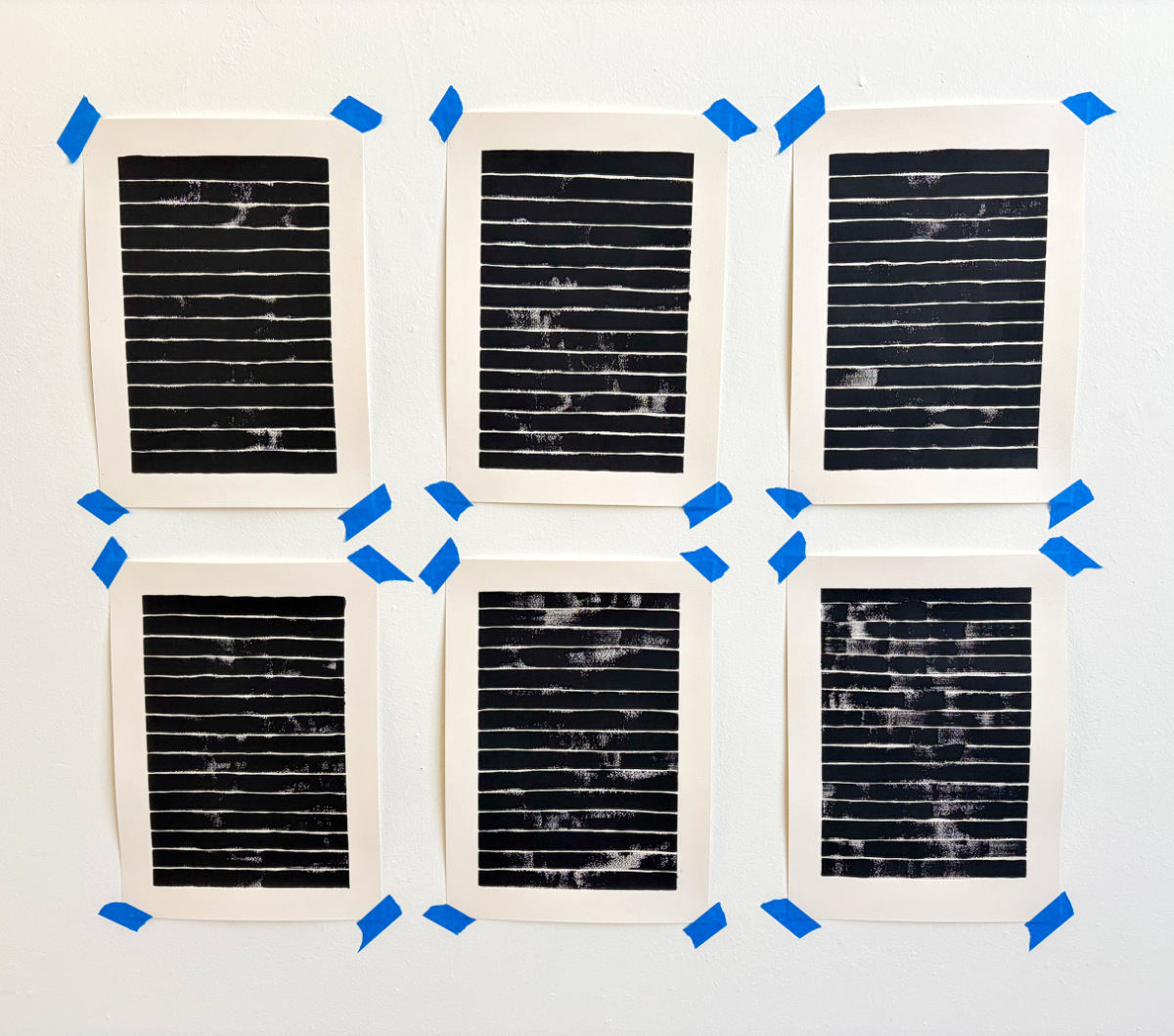
Those that didn’t make it
I want to talk a little bit about failure.
This is a photo of the wall next to my desk where I’m currently working on the 2026 edition of my ongoing series, Standing Still In A Storm. I’ve been doing this project for close to 15 years now, with each year the guidelines changing a little bit. The basics remain the same: painted freehand parallel lines in black gesso that are not allowed to touch but meant to get as close as possible to one another. The paper size, border measurements, and brush width vary year-to-year, but the general rules are always the same.
So far, this year I’ve finished 18 pieces—including these six failures. For one reason or another, each of these did not meet the standards I have for the work. On some the ink bled under the tape (an issue I did not discover until the work was already complete and otherwise satisfactory). On some the slightest twitch of my hand caused the black lines to meet at some point. On others the proportions weren’t right and by the time I got to the last line it ended up wider than the brush I’m using. Whatever the reason, these are the failures—one-third of the work I’ve done so far.
I feel like artists online only ever show their successes. The ones who post process videos only do so when the final work is suitable for publishing. Content creators and influencers crop frames and set up shots that don’t actually represent what they’re doing. The rule of advertising is that everything has to be positive all of the time, and the internet has become one big advertisement for life. It’s all success stories, and I wonder how many of them are outright lies.
The thing is, everybody fails. The process of taking inspiration to creation is an arduous one. Yet in a society that demands better results faster, standards lessen, quality drops, concepts fade, and the finished product is cheapened. It’s no wonder those obsessed with capital love AI—it removes all the parts that take time from creativity, but in doing so it also removes everything that makes a creation good.
Failure is important to process. It’s a learning experience, much more so than achievement. By having this entire sect of culture that only shows finished products, it becomes akin to something between a gallery and a mall. The human values have been lost, and it’s not because people don’t fail, but because in the public eye, they’re not allowed to.
There’s certainly a cynic in me that doubts most ‘philanthropic’ ventures by the wealthy as a dangling set of shiny keys to distract the public from ideas like hiking tax rates by 25%. And there’s even more of me that has a distaste for celebrity press releases about doing good in the world. But when it comes to the $10 million that Olivia Rodrigo’s festival donated to ten women’s-based non-profits—matched dollar-for-dollar by Melinda Gates—I have to set my cynicism aside for a moment.
I have no doubt that there’s an extensive team behind Rodrigo helping to maintain a very specific public image, but that doesn’t change the fact her audience is predominantly young women and girls—a demographic that is facing an increasingly precarious, if not outright dangerous, future. While $20 million isn’t going to realistically do much in the real world of social justice, what the entire festival represents—from being an all-female lineup to supporting organizations that exist to help women in one way or another—is that if you’re a part of a group the system is after, the best thing you can do is take care of each other.
The concert was a cool enough idea, and donations are a good thing, but to me, this was a chance to show an entire upcoming generation that the best weapon against institutional power is organizing and camaraderie. When I was younger, there were organizations like Rock The Vote, but stuff like that still had that undertone of, Believe in the System, believe in America. Rodrigo’s efforts voice a distinct split from that, as if to say, The entire political machine is after us right now. (Which, well, it is.)
I remember reading an interview with Mark of blink-182 when they were first getting big in the late 90s. He replied to a question about them being a ‘punk band’ by saying he thought of them as Fischer-Price Punk—a band that could be someone’s first punk band, an introduction to the genre. It’s not untrue. While for me it was Green Day, there’s always some mainstream influence that can lead people down a path into the subcultures where political activism really starts to take hold, and that’s what I kind of think of this. It won’t create an immediate wave of neo-Suffragettes, but it could be a step in that direction for a chunk of that audience, and in this day and age, that’s good enough.
I’m not gonna be one of those people who pretended to listen to Dolly Parton all along. She had plenty of fans of her music and I won’t pose as one of them. That being said, I was a huge fan of her.
She’s talked about her father’s illiteracy and in her fame started the Imagination Library as a result—an institution which has given kids worldwide over three hundred million books for free. It’s just a part of her extensive philanthropy—giving away so much money that, though she could have been a billionaire, she never reached that mark.
It’s rare to have a public figure in America almost always walk the walk without talking too much talk—but when she did speak about issues, it was always in a way that expressed a kind of belief in the human spirit and the understanding that we’re all just equal as human beings. Though her works that help people will be recognized and missed, to me it’s that she represented a quality of understanding and respect for all that is largely lost on those with power and influence in media and culture.
In an era of Kardashians, where amassing wealth and dismissing others and focusing on the self is paramount—embracing individualism and greed—Parton represented the polar opposite. She was an example that one could be both accomplished, loved, and rich without holding on to ideas that were exclusionary or discriminatory. If celebrity is an inescapable consequence of the collision of art and commerce, Dolly was an example that the role could be a path to mutual benefit (as much as something like that can be).
I think that’s the reason so many people are fucked up over her death. In a time when nobody agrees on anything, everyone knows that Dolly Parton was an amazing person. A representation of goodness, of what people could be. There’s something in the air now where we can all tell society has sunk so far into greed, selfishness, and sometimes outright evil, that we’re collectively losing the plot—that there aren’t really many people left to consider a role model for the next generation.
She will be missed, and perhaps her legacy will inspire the youth of today to see that society does recognize the good in people, and collectively lifts them up, giving them deserved recognition for being a beacon of what the human heart is capable of. The world will be a worse place without Dolly, but maybe because of her, people will end up a little better.