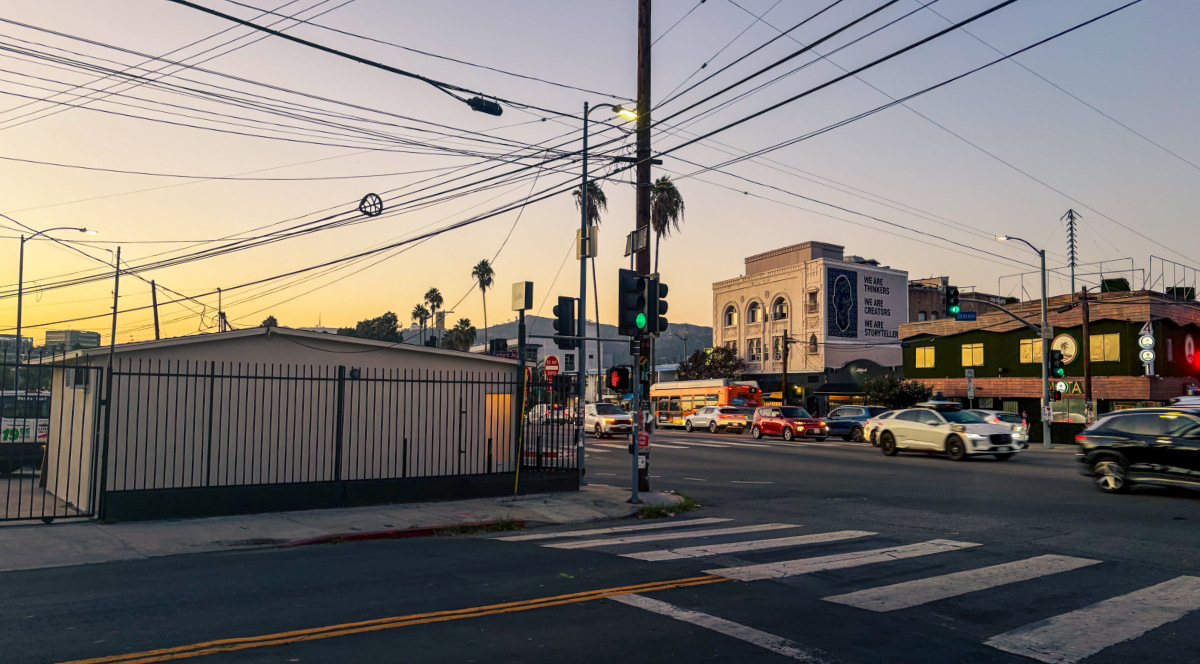
Sunset Junction in Silver Lake
Sunset Junction in Silver Lake
One of the maddening parts of LA culture is that some restaurants are hot spots to be seen in, and so they probably get more business than the food actually deserves. When you don’t know this before making a reservation, you end up overpaying for a mid meal just because the place is on a trendy block off Sunset. Whoops.
(Then there’s always the later part of the night where driving becomes a competitive sport while street signs and traffic lights are largely disregarded and double parking and careless pedestrians crowd every other street. Sometimes I think the 2028 Olympics should feature a special LA-based contest called Taking Your Life In Your Hand By Driving Down The 110 From Highland Park To The 10 West After Dark.)
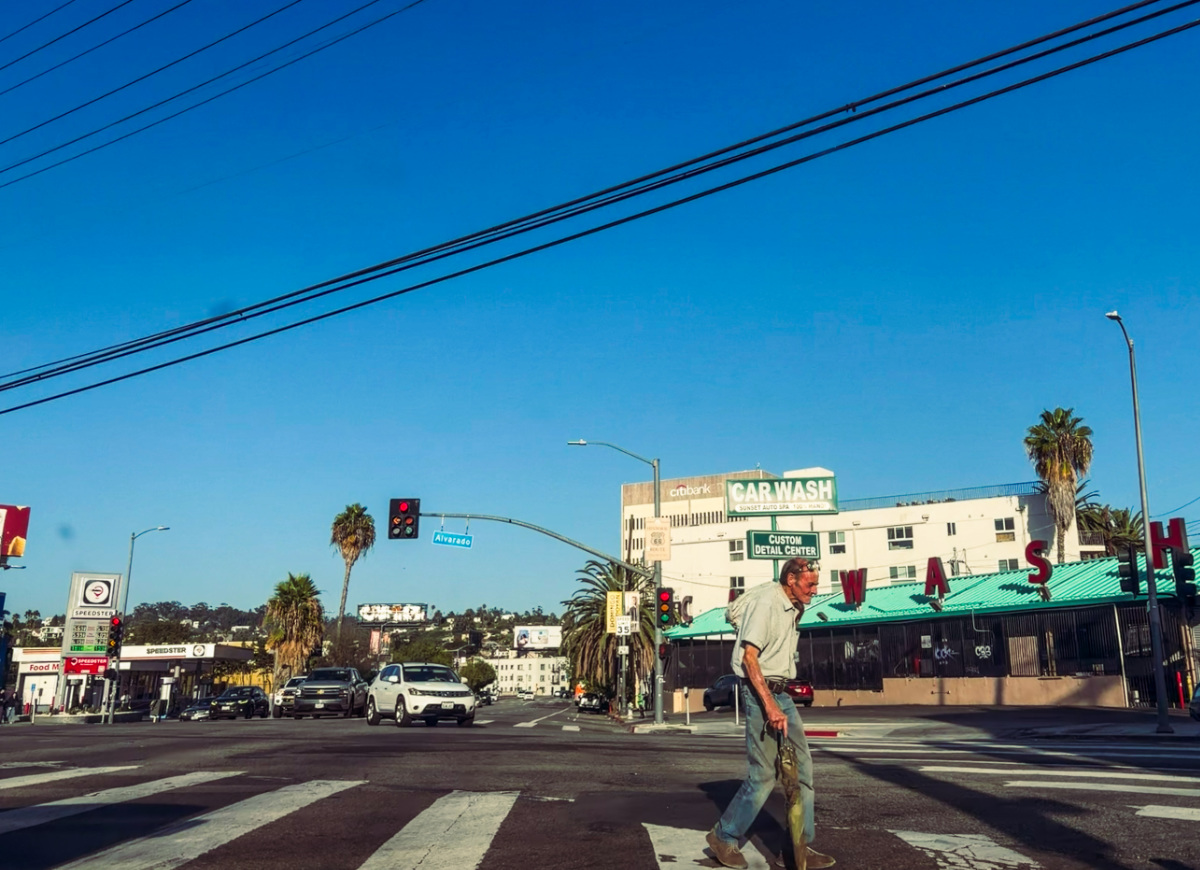
Alvarado and Sunset
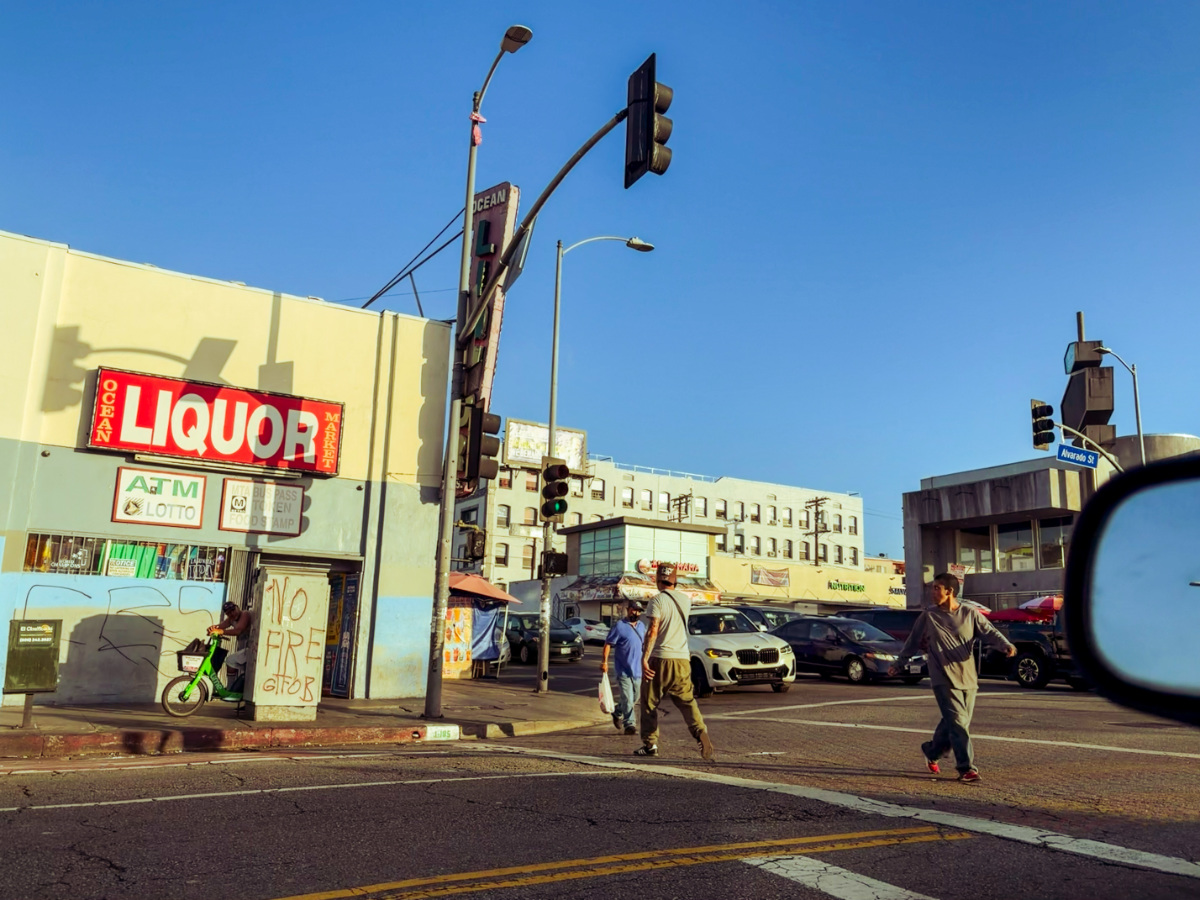
Alvarado and 8th
I remain intrigued by photographing intersections while I’m waiting on the light—although I will say since moving to Westlake I am amazed at how many people on foot or scooter or bike just do not care about what light is which color at any given time.
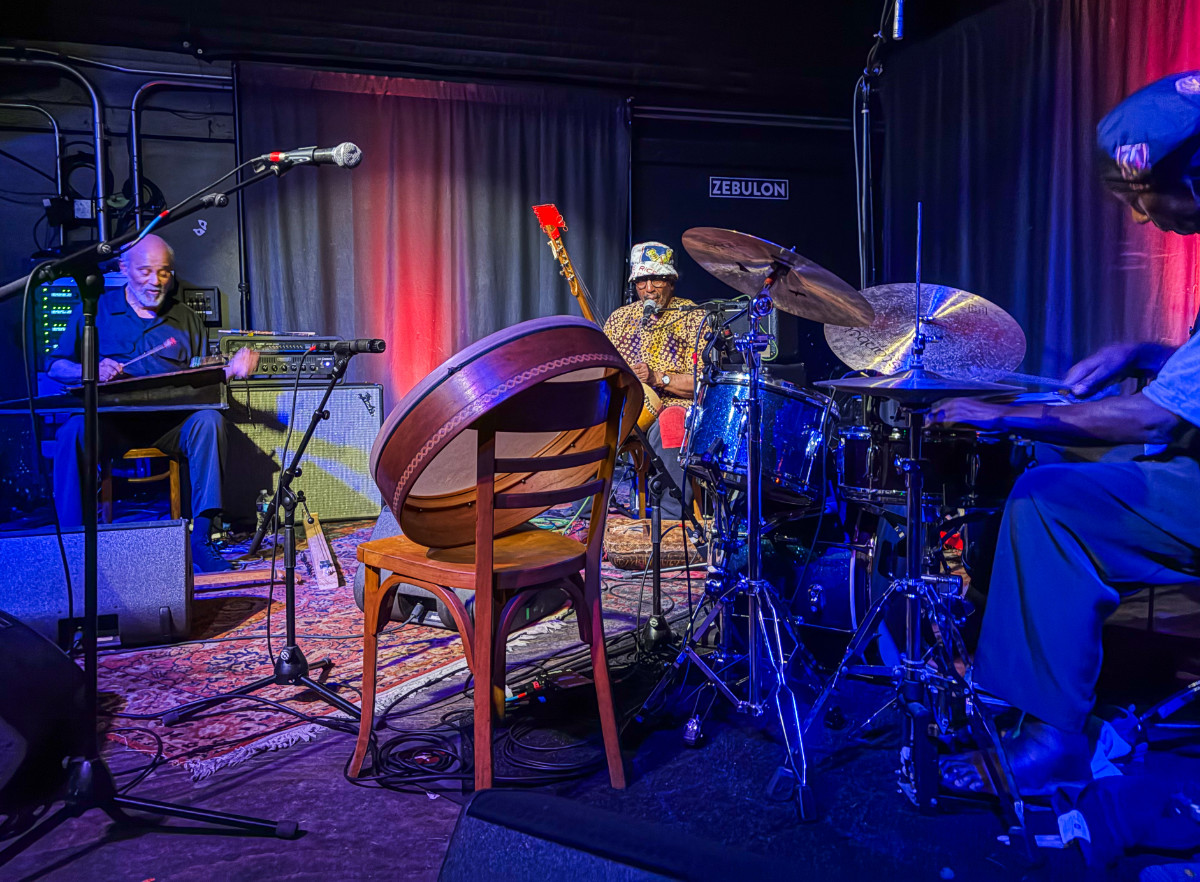
HEART Trio tonight at Zebulon
Saw the HEART Trio of William Parker, Cooper-Moore, and Hamid Drake tonight and it’s one of those performances that can’t be put into words. At one point Cooper brought out what looked like a two-by-four with a string lined between two blocks of wood and hit a bass tone so deep that it shook us in the front row. I mean the guy was playing hand-made, one-of-a-kind instruments that looked like they’d been assembled from things found on the side of the road (and some of them were), but damn if these guys couldn’t play.
The show wasn’t sold out, so that means under 300 people in a city of eight million saw this incredible performance. Which is fine, different strokes for different folks. But it’s such a cool thing to live in a place where on any given night I can go to a club and sit in the front row as some jazz legends blow my fucking hair back with some improvisational music that has no counter.
After the show ended the guys talked about the instruments they played and how they related to the history of music and really brought their performance full circle into shifting from hearing those relationships in sound to comprehending them through language. This was music that seemed to transcend the bullshit of the world and tap into something pure. Absolutely wonderful.
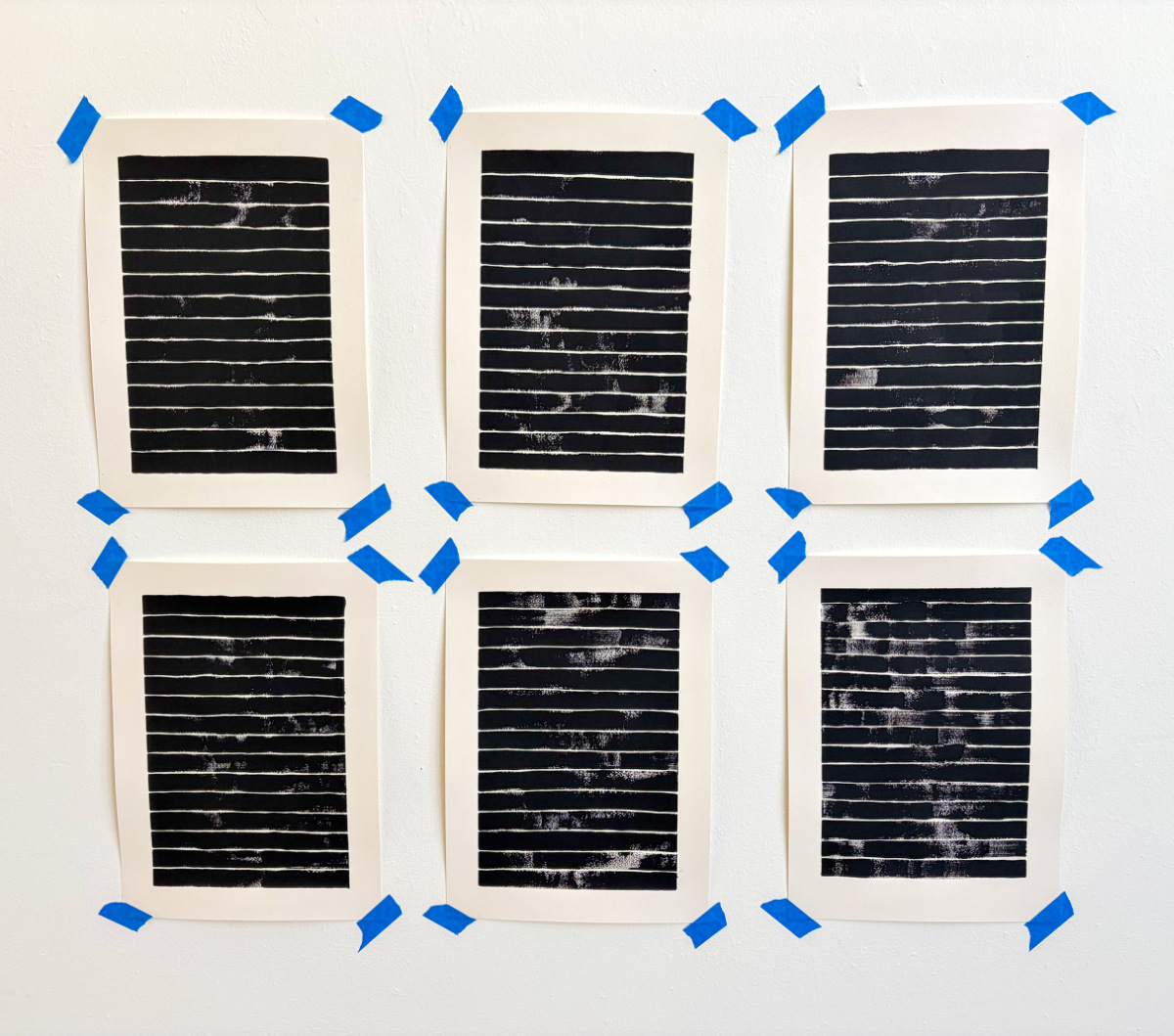
Those that didn’t make it
I want to talk a little bit about failure.
This is a photo of the wall next to my desk where I’m currently working on the 2026 edition of my ongoing series, Standing Still In A Storm. I’ve been doing this project for close to 15 years now, with each year the guidelines changing a little bit. The basics remain the same: painted freehand parallel lines in black gesso that are not allowed to touch but meant to get as close as possible to one another. The paper size, border measurements, and brush width vary year-to-year, but the general rules are always the same.
So far, this year I’ve finished 18 pieces—including these six failures. For one reason or another, each of these did not meet the standards I have for the work. On some the ink bled under the tape (an issue I did not discover until the work was already complete and otherwise satisfactory). On some the slightest twitch of my hand caused the black lines to meet at some point. On others the proportions weren’t right and by the time I got to the last line it ended up wider than the brush I’m using. Whatever the reason, these are the failures—one-third of the work I’ve done so far.
I feel like artists online only ever show their successes. The ones who post process videos only do so when the final work is suitable for publishing. Content creators and influencers crop frames and set up shots that don’t actually represent what they’re doing. The rule of advertising is that everything has to be positive all of the time, and the internet has become one big advertisement for life. It’s all success stories, and I wonder how many of them are outright lies.
The thing is, everybody fails. The process of taking inspiration to creation is an arduous one. Yet in a society that demands better results faster, standards lessen, quality drops, concepts fade, and the finished product is cheapened. It’s no wonder those obsessed with capital love AI—it removes all the parts that take time from creativity, but in doing so it also removes everything that makes a creation good.
Failure is important to process. It’s a learning experience, much more so than achievement. By having this entire sect of culture that only shows finished products, it becomes akin to something between a gallery and a mall. The human values have been lost, and it’s not because people don’t fail, but because in the public eye, they’re not allowed to.
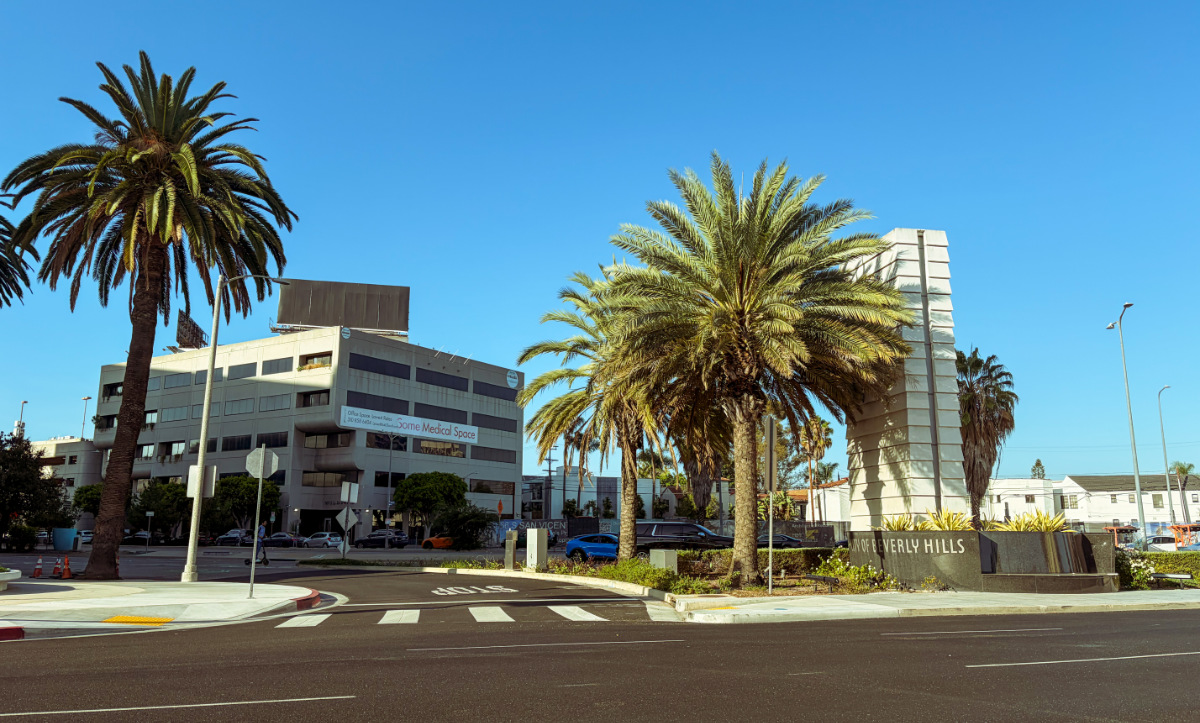
Wilshire and San Vicente
I had to get a new phone today. After years and years with my old iPhone SE, the screen cracked for the first time after I dropped it on Tuesday. The phone is so old that the repair shop didn’t have any screens in stock that would fit it. For some time now, it’s been slowly dying due to the increasing size of iOS and mobile apps, and so I took this as the final sign it was time to finally upgrade.
So I bought a new phone this afternoon. Afterward I had to go to Beverly Hills for a medical appointment, and I found myself sitting in the waiting room with some time to kill. Fiddling with this new iPhone, trying to figure out why Apple has made iOS so ugly over the past few years, I was struggling. Holding the phone along the base as I am used to, my thumb couldn’t reach the navigation buttons at the top of the screen—an action that was pretty simple on the SE. This seems like a flaw in basic functionality from a product design point of view, as my hands are a pretty decent size and should have no trouble reaching across a screen.
It felt really appropriate I was discovering this new inconvenience in Beverly Hills.
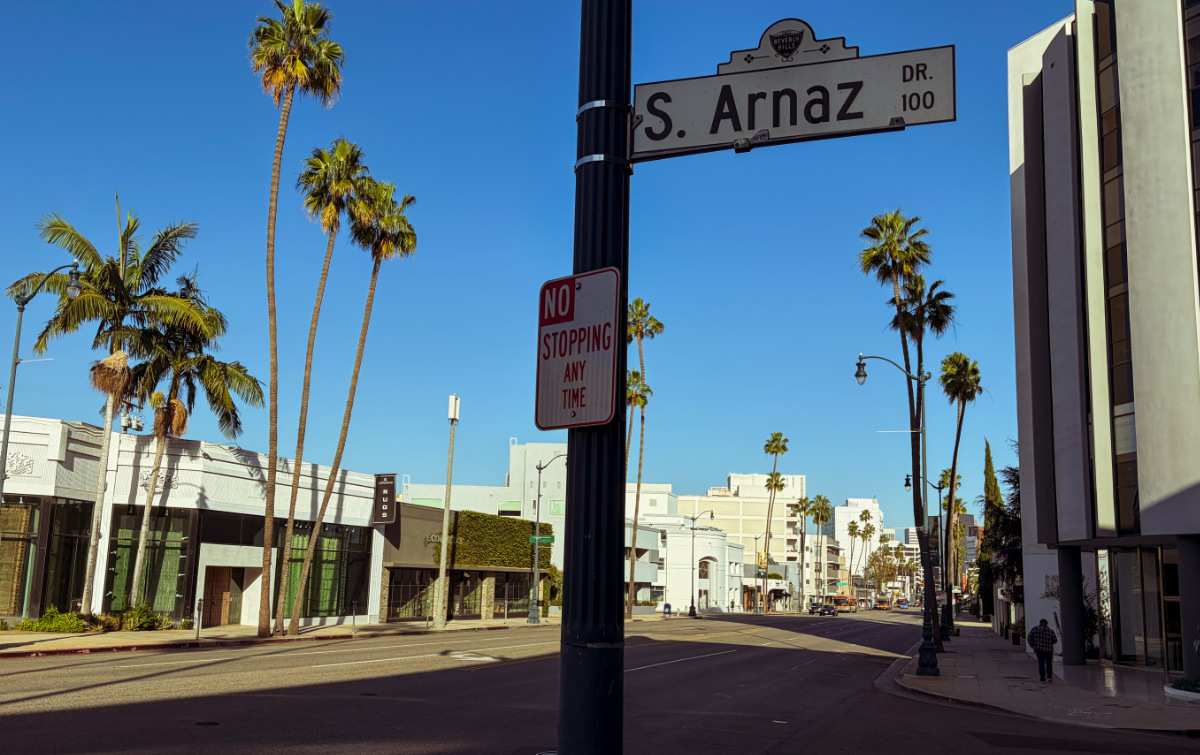
South Arnaz and Wilshire
Ten years ago, the iPhone was a perfectly fine device that was well-designed and comfortable. Somewhere along the line, though, that American idea of Bigger is Better seemed to take hold and the phones became more like mini-tablets. (I held on to my old phone for so long because it was the same size as an iPhone 6, which was nearly perfect.)
But in America, we take what we can get even—and especially—when we don’t need it. Beverly Hills is the type of city that exemplifies this idea. The palm trees, taller than most in the rest of LA, soar above Wilshire Boulevard. The showrooms for supercars that couldn’t be driven on a majority of the pothole-laden streets of Los Angeles appear sandwiched between realty estate agencies and hot yoga studios. The ostentatious houses that could reasonably house six families have two luxury cars in the driveway.
This sickening need for excess factors in at scale, from the obscene lifestyle indulgences of Beverly Hills down to the fact the smallest phones on the market are too big to fit comfortably in the hands of a grown man. The fundamentals of design are based around function, and we’ve warped that under capitalism to prioritize form, often to the detriment of everything else. Be they systems of urban infrastructure and city planning to products being of lower quality while getting more expensive, the language of constructing our physical reality has been upended by the profit motive.
God I hate going to Beverly Hills.