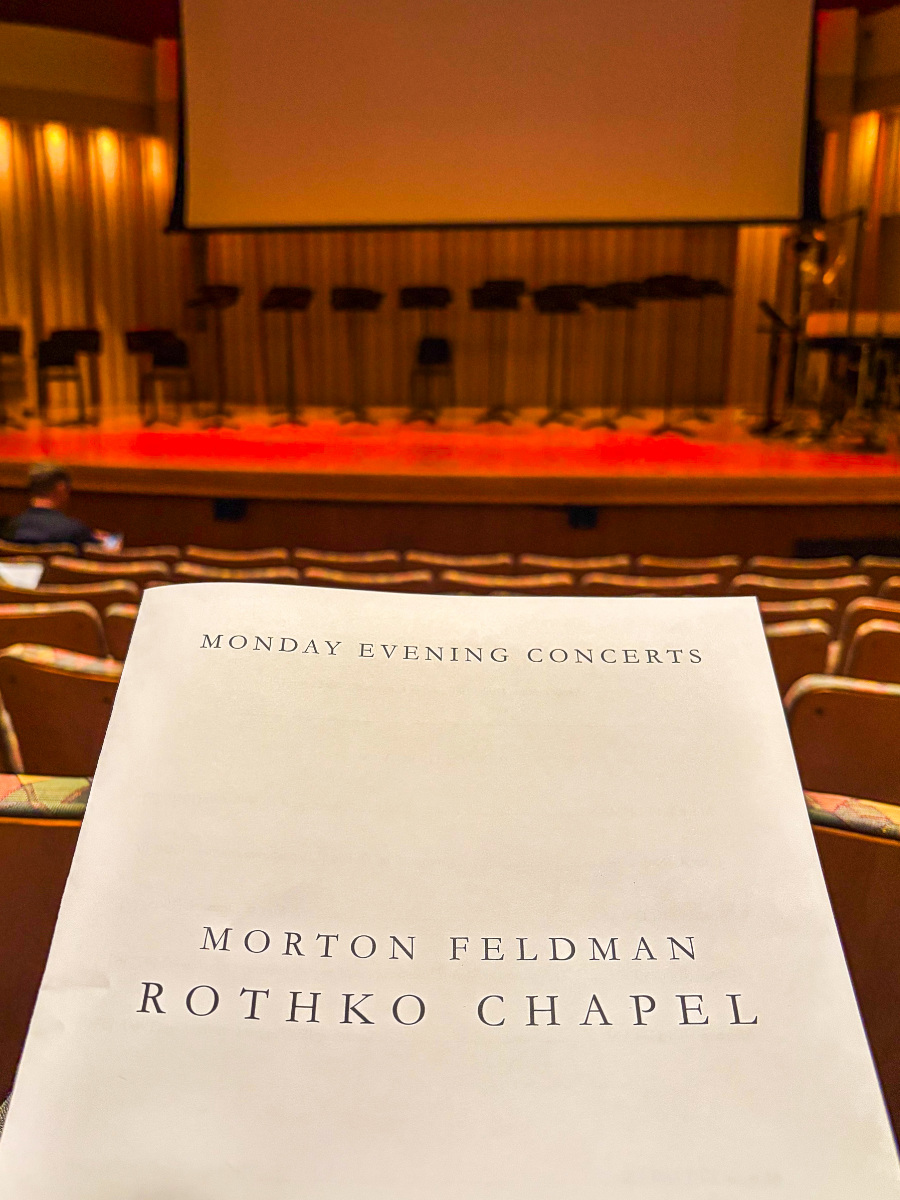
Morton Feldman Rothko Chapel program
Morton Feldman Rothko Chapel program
I was lucky enough to attend the sold-out performance of Rothko Chapel (among a few other, shorter works) that the Monday Evening Concert series put on tonight in honor of what would have been Morton Feldman’s 100th birthday (at least, earlier this year). It’s the second show celebrating Feldman I saw this week—last Friday, Oracle Egg had BlackBox Ensemble perform a similar event with different works.
Now, full disclosure, I knew nothing of Feldman before these concerts. While I listen to plenty of avant-garde music, it’s often in the shape of post-rock-adjacent bands or weird things I see at sparsely-attended local shows where someone has an array of objects they turn into something between a harmony and an unstructured wall of noise. The sort of high-brow, famous and studied crowd isn’t something I’m really familiar with.
That’s why I was particularly fond of hearing this performance tonight. I had no clue what to expect—it was honestly my love of Rothko more than anything that made me buy a ticket to begin with. But I left completely stirred by the music.
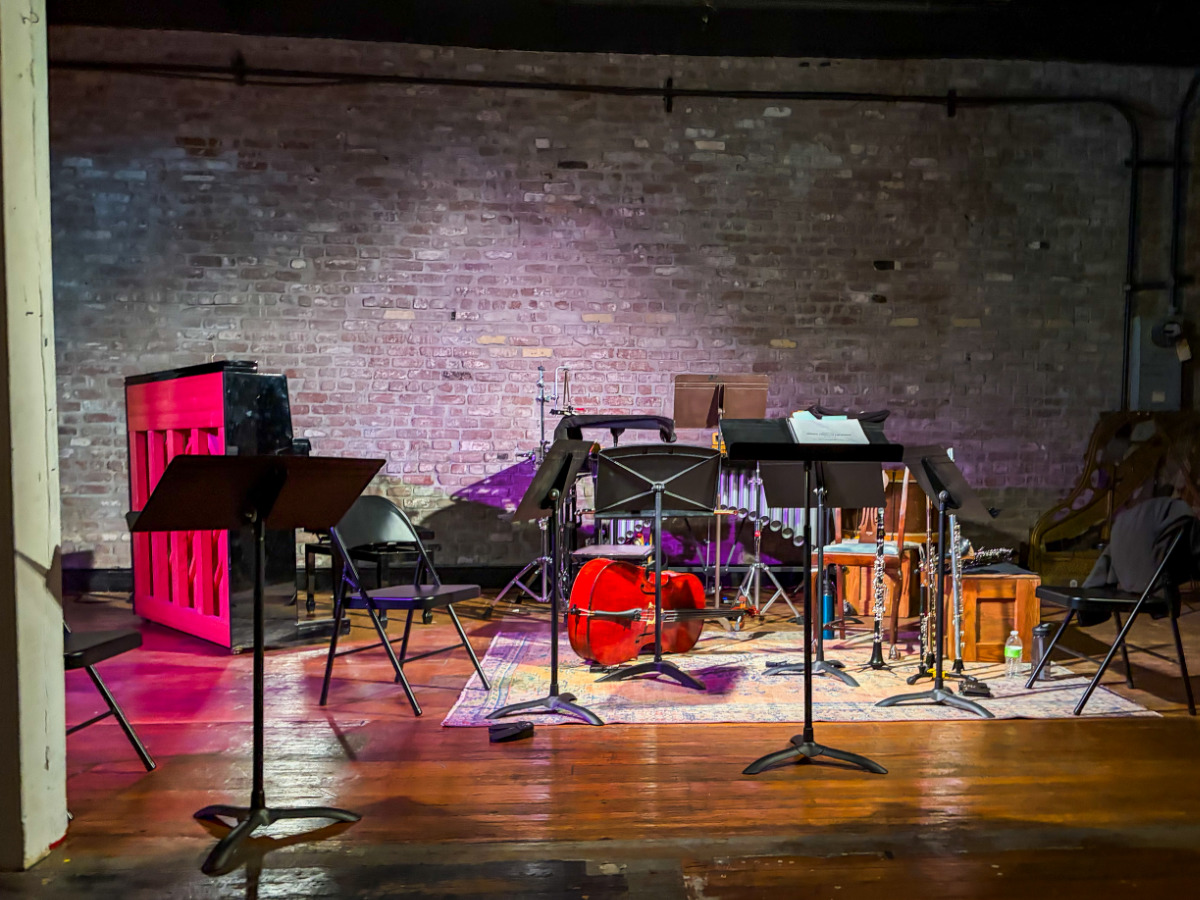
Performance set-up at Oracle Egg
This is the wonderful thing about experiencing art in general—there’s no telling how seeing Rothko Chapel will affect me or the work I make down the line, but it undoubtedly will, somehow, even if I am not fully aware of it. It feels almost stupid to write out—how taking in something creative can provoke inspiration—but we live in really stupid times when people are actively working against the idea that art made by humans has a place or purpose in life.
Beyond my ongoing laments about AI, though, seeing this made me both glad to be in Los Angeles but saddened by how capitalism all but ruins these types of performances for so many people by not allowing an avenue for them to be experienced at all. A ‘market’-based economy will always be cruel to the arts because it’s generally unpredictable what, if anything, will even break even with a financial investment (much less be any kind of success). Major cities generally have enough demand for a variety of cultural options that many forms of art can cultivate audiences; mid-sized cities are lucky to have one independent theater and a liberal arts college that offers annual concert series. Rural areas are basically fucked beyond anything that doesn’t play in a national, corporate movie theater chain.
Experiencing art helps develop abstract thought. When ten people see the same movie, even one that might be ‘philosophical’ in nature, they are all presented with the same basic concept in their heads because the plot of the film poses questions it seeks to answer. Perhaps it’ll make the people think about variations of that question, but all ten people will have fairly concentrated thought processes. Taking in an experimental concert, or looking at abstract paintings, makes the ten people come up with their own questions before trying to reach a conclusion. The experience itself provokes so much more than what entertainment provides for—it has the potential to spur on more conversations, develop greater ideas, and make people more open in general.
As ideas are being chiseled away at and culture that doesn’t embrace corporatism is stifled, it feels like we’re all losing out. Violence seems inevitable at this point, and I can’t help but think that’s partially due to the fact so much of what we see and hear and experience on screens of any sort keeps pointing in that direction. We all end up thinking in similar patterns of decay because that’s all we’re shown in the dominant forms of media. It’s all just so sad, and I guess the music was bringing all that up tonight.
I hate The Grove. It’s one of two gaudy, outdoor malls in Los Angeles by a billionaire who lost the race for mayor four years ago (the other being The Americana). In the past, I’ve found myself at the latter to catch a movie in the middle of the day because it’s down the street from my mechanic and I’d need to kill a couple hours while my car was in the shop. The Grove, though, I avoided at all costs.
Now, I can’t. At least not if I want to see a new movie.
Since theaters re-opened in 2021 or 2022, I’ve been using AMC’s A-List membership. I see a shit-ton of movies and the cost pays for itself if I go just twice a month. However, I’ve also lived in East Hollywood that whole time—just a 12-minute drive from the Burbank multiplex with its 30 screens and free parking.
A couple months ago, I moved into what is basically my dream place. There’s really nothing to complain about—except now that I’m in Westlake, Burbank is a much further drive and now the closest AMC theater is at The Grove, with its 14 screens and $6 parking.
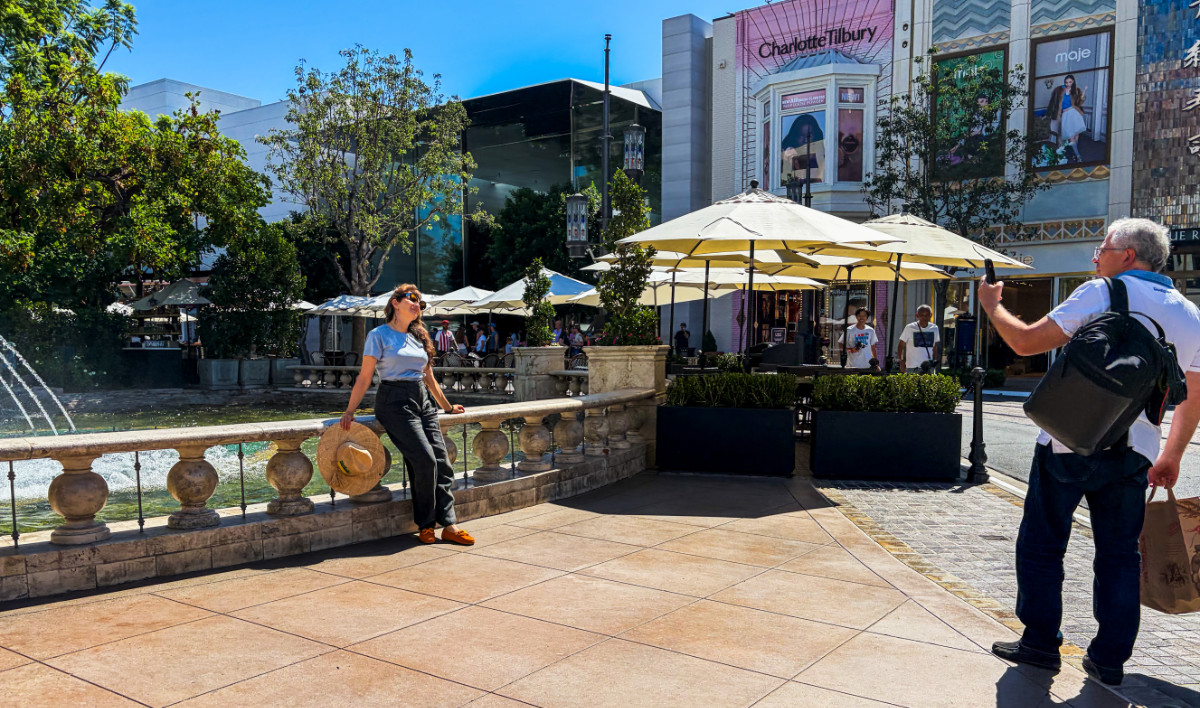
An afternoon at The Grove
There are any number of reasons I hate this place. An outpost of capitalism, there’s a kind of faux classiness to it all. There are ‘luxury’ stores but the experience of being at one of these malls is anything but. It’s the shopping center version of pleather. (Kind of ironic given Rodeo Drive is just three miles west, down Third to Beverly Hills.)
One thing going to The Grove does for me though, is that it reminds me how different people can be. It’s a real removal from my comfort zone. I walk around completely confused as to how people of all ages go to this place willingly and un-ironically, just to like, hang out. It is mystifying.
Consumerism in America is so central to national identity that places like The Grove really make me think about how the notion of what you want at a material level seeps in to every aspect of life—how being presented with certain options is disguised as being catered to, and what that means for how we view our politics. These sorts of places use the model of collective gathering to spur on the notion of individualism, and I think that’s far more destructive to the human condition of living in the United States than the specific economic model of capitalism (though the two are inextricably linked).
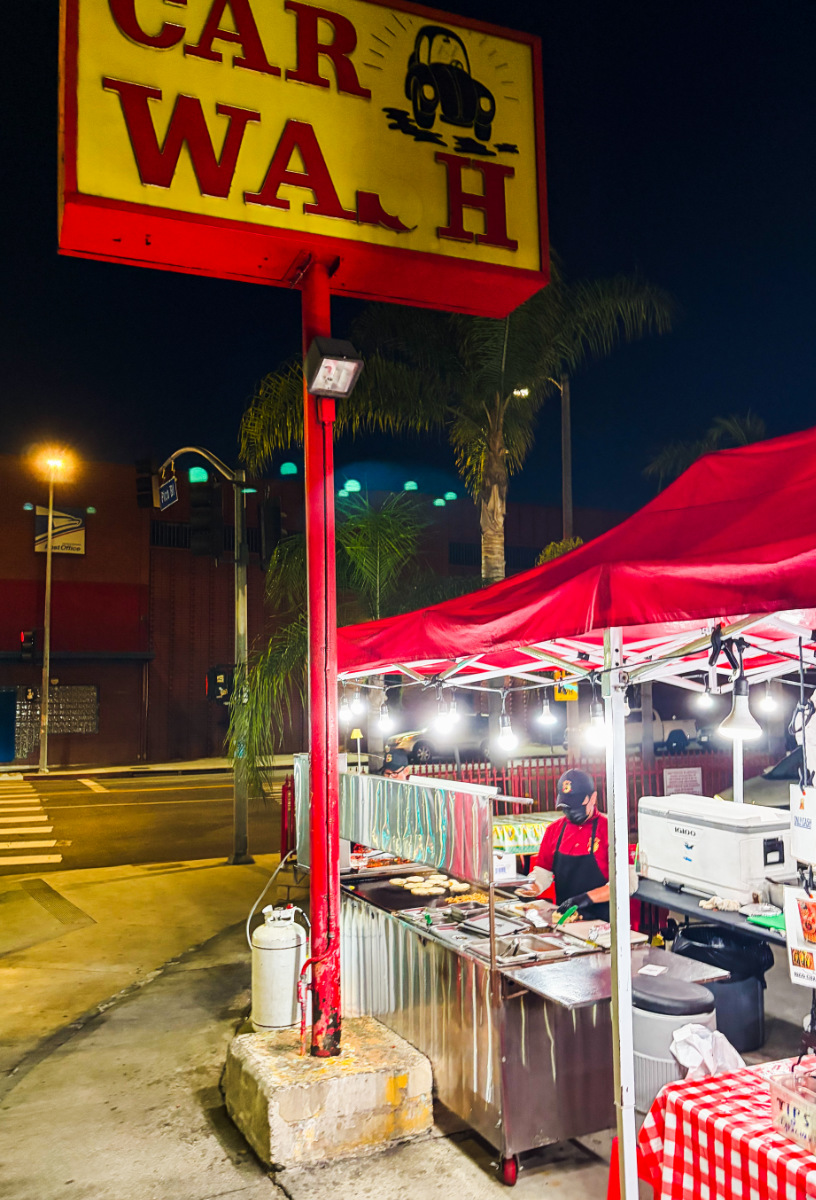
Leo’s on Pico
Picking up al pastor tacos from Leo’s has been a long-standing late-night lifesaver for me when I forget to go to the grocery store on any given day. Needed such a thing today and found out there’s a location not ten blocks from my new digs. Getting delicious tacos from the parking lot of a car wash while a few college kids smoke a joint and clean an old Hyundai Elantra a couple bays up is certainly a vibe.
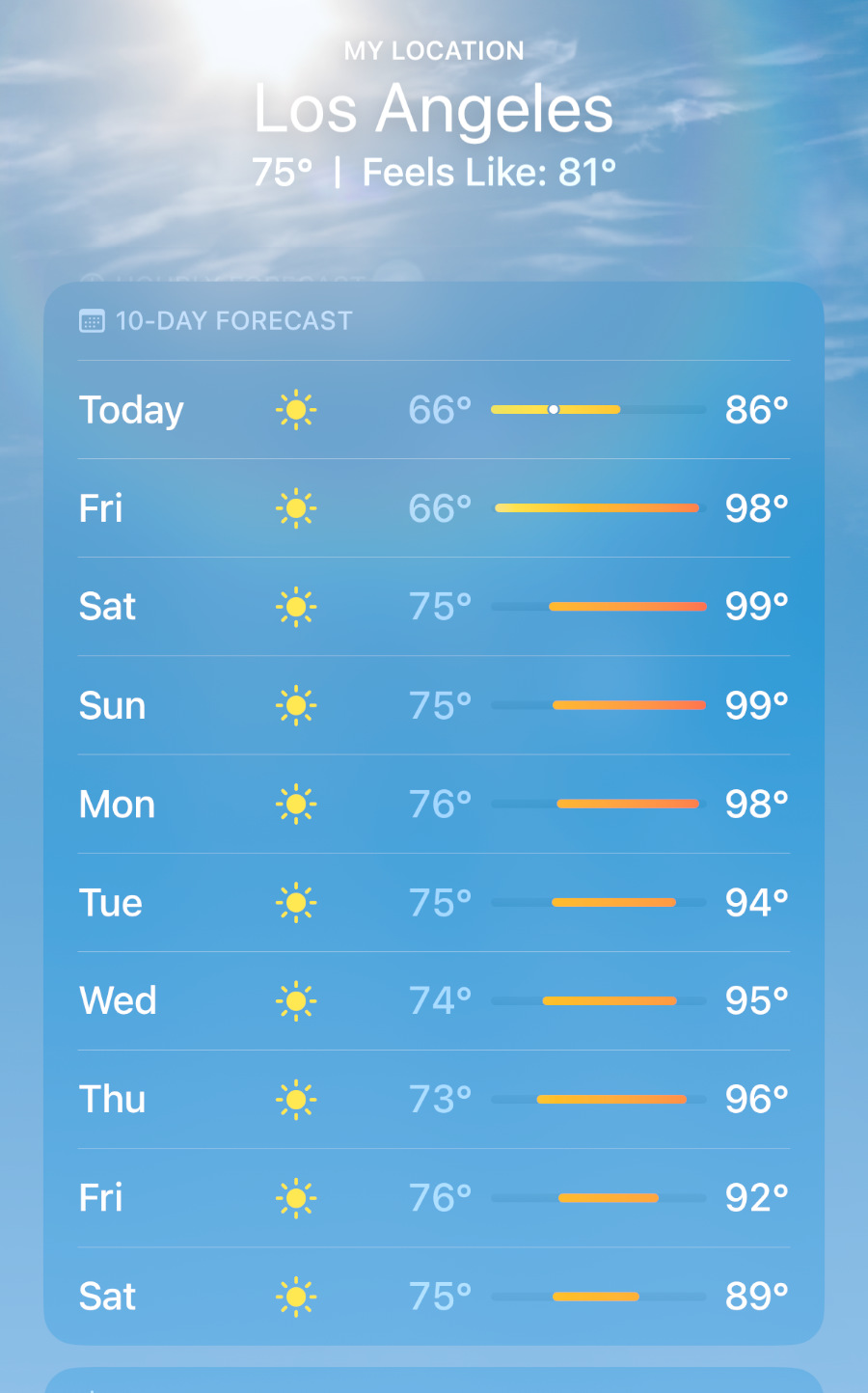
Ten-day outlook
What in the absolute fuck.
This will now be the third heat wave this summer where temperatures reach in the mid-to-high-nineties for over seven days in a row. Granted, this is only my sixth summer in LA, but nothing has come close to this since I’ve lived here.
After a rather brutal August into September heat wave, Los Angeles is finally settling into normal weather for this time of year. I look at my portable AC with hesitation—I feel like putting it away for the winter is tempting fate that we’ll get hit with another week of 90 degree lunacy. The beach is only 10 miles away but it takes 45 minutes to get there. Sometimes living in this city just feels absurd.
One of the difficulties with sobriety is that addicts are obsessive and tend to replace their habit with another, arguably less destructive, one. For me it’s been TV and movies. I feel less bad about the latter, but watching too much television feels gross. I know how bad it is for the mind, I’ve read enough media theory. It’s a problem that I’m trying to use music and reading to beat, but I consider it just as bad as drinking.
So here’s a list of stuff I’ve been listening to on a lazy Saturday afternoon:
Wilshire Kingsley
Those Who Walk Away, Afterlife Requiem
Kind of drone, kind of melodic; this is one you just kind of get lost in. I’ll put it on while working and parts will just come out and grab my attention out of nowhere.
Songs: Ohia, The Lioness
Totally slept on this for years, even though I love Didn’t it Rain. Just sad songs and beautiful guitar work from the late, great Jason Molina.
Gillian Welch, Time (The Revelator)
Possibly the best singer-songwriter album of the 21st century. Though it was written about Napster, “Everything is Free” is more meaningful than ever. Not a second of this is less than perfect.
Tim Hecker, Dropped Pianos
Different than most of Hecker’s more intense and varied work, this is short and sweet piano and organ music that keeps a pretty morose but enchanting experience.
The National, Rome (Full Concert)
This is half-full of songs I really didn’t like on their Frankenstein album that are completely different when played live. I just wish they’d played “Slow Show.”
Charli XCX, Wuthering Heights
I kind of disdain Charli’s cultural presence in general, but it’s hard to deny this record is just banger after banger. Just a monster of a pop album that will probably be my favorite of the year.
Radwan Ghazi Moumneh & Frédéric D. Oberland, Eternal Life No End
Excellent worldly music from this Middle Eastern duo that fuses a lot of traditional sounds from that part of the world with driving, electronic-inspired percussion.
Jason Isbell, Foxes In The Snow
I have been kind of mixed on his work since Southeastern, but this acoustic album about a breakup and falling in love with someone new is full of what it means to endure the extremes in relationships.